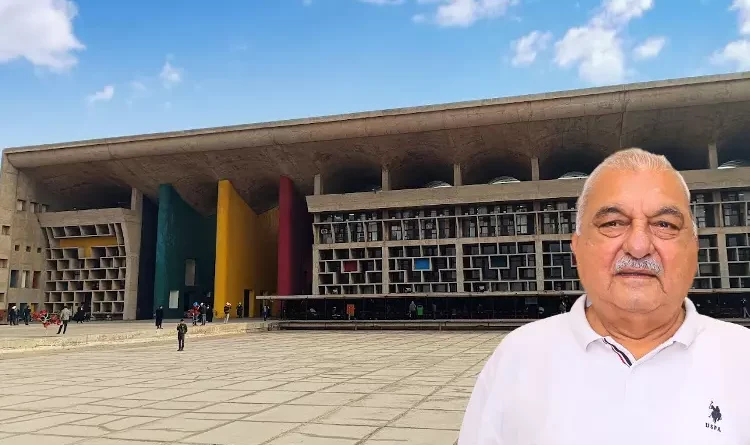
Punjab & Haryana HC Dismisses Bhupinder Singh Hooda’s Plea to Stay Trial in Land Acquisition Case
Former Haryana CM’s bid to postpone corruption trial rejected; court says he cannot use co-accused stays as shield
Chandigarh, November 7, 2025 — The Punjab and Haryana High Court has dismissed former Haryana Chief Minister Bhupinder Singh Hooda’s petition seeking postponement of trial proceedings in a corruption case related to alleged irregularities in land acquisition at Manesar.
Justice Tribhuvan Dahiya rejected Hooda’s plea, ruling that the former CM cannot impede the trial merely because some co-accused have obtained stays from the Supreme Court. The court observed that Hooda had accepted a December 2020 order directing framing of charges against him by not challenging it, and cannot now use interim relief granted to others as grounds for delay.
The Case Background
The case stems from an FIR registered in August 2015 regarding alleged deliberate lapsing of land acquisition proceedings in Manesar, Gurugram. The Central Bureau of Investigation took over the investigation and filed a chargesheet in December 2018 against Hooda and multiple co-accused under charges of cheating, conspiracy, and corruption.
The allegations claim that Hooda, as Chief Minister, along with senior government functionaries including the Principal Secretary, Additional Principal Secretary, and officials from the Town and Country Planning Department, conspired to allow land acquisition proceedings to lapse by ensuring compensation awards were not passed within statutory timelines.
Landowners were allegedly forced to sell their holdings under threat of acquisition, after which various licenses and change of land use permissions were issued to ineligible builders. This allegedly caused substantial loss to the state exchequer and wrongful gain to private entities.
Key Court Observations
The High Court noted that while some co-accused — including senior bureaucrats Murari Lal Tayal, Chattar Singh, Sudeep Singh Dhillon, and Jaswant Singh — obtained stays from the Supreme Court after challenging their discharge rejection, Hooda never contested the trial court’s December 2020 order against him.
“The petitioner himself has not challenged the order declining his application for discharge. It has attained finality qua him, leaving no option with the trial Court but to frame the charge,” Justice Dahiya observed.
The court dismissed Hooda’s argument that charges of conspiracy cannot be framed against him alone in the absence of co-conspirators whose trials are stayed. It noted that Hooda faces charges beyond conspiracy, including under the Indian Penal Code and Prevention of Corruption Act, which can proceed independently.
“His attempt to do so is imprudent and clearly an afterthought as he has accepted the order directing framing of charge against him,” the judgment stated.
No Stay on Corruption Trials
The court reinforced the Supreme Court’s precedent in Satya Narayana Sharma v. State of Rajasthan (2001), which establishes that trials under the Prevention of Corruption Act cannot be stayed by High Courts, even in exercise of inherent jurisdiction under Section 482 of the Criminal Procedure Code.
Justice Dahiya cited observations from that judgment highlighting how corruption cases are delayed when accused obtain stays through revision petitions. “Corruption in public offices is becoming rampant,” the Supreme Court had noted, emphasizing the need to prevent trial delays in such cases.
The High Court clarified that while petitions under Section 482 can be entertained in appropriate cases, there can be no stay of trials under the Prevention of Corruption Act merely because the court cannot immediately hear the petition.
CBI’s Stand
The CBI, opposing Hooda’s plea, argued that the case was registered pursuant to Supreme Court directions and any postponement would violate those directions. The agency maintained that there was no infirmity in the trial court’s rejection of Hooda’s postponement application, particularly since he had not challenged the charge-framing order himself.
What’s Next
With the High Court dismissing his petition, the trial court can now proceed with framing formal charges against Hooda and other accused who do not have stays from the Supreme Court. The case relates to alleged irregularities that occurred during Hooda’s tenure as Haryana Chief Minister.
The prosecution will be able to record evidence and examine witnesses, even as proceedings against some co-accused remain stayed pending their appeals before the Supreme Court. If those stays are eventually vacated, the co-accused can be charged separately and evidence taken against them at that stage.
This report is based on the order pronounced by Justice Tribhuvan Dahiya on November 7, 2025, in CRM-M-56380-2025.