Srinagar’s Nowgam Police Station Devastated by Massive Explosive Blast: 9 Dead, Including SIA Inspector and Constables
Accidental Detonation of Seized Ammonium Nitrate Kills Police, Forensic Teams, and Civilians; Body Parts Found Up to 600m Away, Mystery Over Trigger Without Detonator Grows
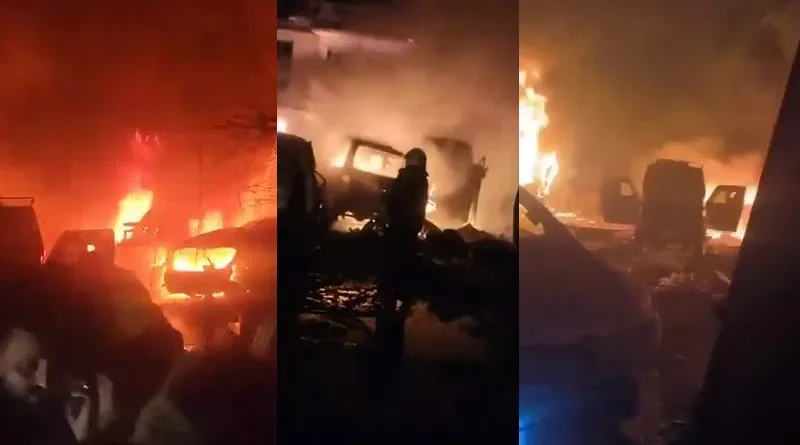
Srinagar, November 15, 2025 – A catastrophic explosion tore through the Nowgam police station on the outskirts of Srinagar late Friday night, claiming nine lives—including a State Investigation Agency (SIA) inspector, several constables, forensic experts, and civilians—while injuring 32 others. The blast, described by officials as an “unfortunate accident” during the sampling of confiscated explosives, hurled body parts as far as 300-600 meters, with eyewitnesses recounting the horrific sight of a human skull plummeting from the sky amid the chaos.
The incident unfolded around 10:30 PM, shattering windows in nearby homes and sending shockwaves audible up to 30 km away. Jammu and Kashmir Director General of Police (DGP) Nalin Prabhat confirmed the tragedy stemmed from the handling of ammonium nitrate-based explosives seized just days earlier from Al-Falah University in Faridabad, Haryana, as part of a probe into a “white-collar terror module” linked to Jaish-e-Mohammed (JeM). “This occurred while our team was following standard procedures to collect forensic samples,” Prabhat stated in a press briefing, emphasizing that no detonator was involved, raising questions about the material’s instability.
The Human Toll and Harrowing Eyewitness Accounts
Among the deceased were SIA Inspector Israr Ahmad Shah from Kupwara, Selection Grade Constables Javaid Mansoor Rather and Arshid Ahmad Shah (both Crime Branch photographers), Selection Grade Constable Aijaz Afzal Mir, and Constables Mohammad Amin Mir and Showkat Ahmad Bhat (all from the Forensic Science Laboratory). Revenue official Naib Tehsildar Muzaffar Ahmed Khan, local chowkidar Suhail Ahmad Rather, and tailor Mohammad Shafi Parray—who had been summoned to the station twice that day—were the other victims.
Parray’s family, still reeling, told reporters he had visited the station in the morning and evening at police request, unaware it would be his last. “We heard the deafening roar around 10:30 PM and rushed out to help the wounded,” a relative recounted. “But then we saw it—a skull falling from the sky, landing near our house 400 meters away. It was unimaginable.” Residents described a scene of pandemonium, with dismembered remains scattered across fields and rooftops, some up to 600 meters from the site. “I saw limbs in the trees,” one local whispered, as volunteers aided in the grim recovery effort.
The injured, many with severe burns and shrapnel wounds, were rushed to the Army’s 92 Base Hospital, SMHS Hospital, SKIMS Soura, and Ujala Hospital in Nowgam. Officials warn the death toll could rise as some remain critical.
Links to Broader Terror Probes and the Delhi Red Fort Blast
The explosives—approximately 2,900 kg including potash, phosphorus, reagents, and bomb-making components—were transported to Nowgam after a joint operation uncovered a sophisticated terror network involving radicalized professionals, including Kashmir-based doctors in touch with Pakistani handlers. This module was tied to JeM propaganda posters circulating in the area, which Nowgam police had cracked earlier.
Strikingly, the ammonium nitrate mirrors the substance suspected in Tuesday’s deadly car blast near Delhi’s Red Fort, where a white Hyundai i20 driven by Dr. Umar Nabi exploded at a traffic signal, killing 13 and injuring dozens. That attack, also without a visible detonator, has intensified fears of a coordinated “white-collar” threat exploiting everyday professionals. Union Ministry of Home Affairs (MHA) officials, briefing on Saturday, urged against speculation but confirmed a high-level inquiry into both incidents’ handling protocols.
The Nowgam station, a key outpost in Srinagar’s southern fringes, was left in ruins—its structure collapsed, walls crumbled, and the surrounding area littered with debris. Security forces cordoned off the site, with roads sealed and civilian access barred.
Official Response and Calls for Accountability
J&K Lieutenant Governor Manoj Sinha expressed anguish, announcing ex-gratia payments of ₹10 lakh to families of the deceased and ₹2 lakh for the injured, alongside compensation for damaged properties. Chief Minister Omar Abdullah pledged a thorough probe, while Deputy CM Surinder Choudhary decried the “repeated negligence” in violence-plagued regions. Congress leader Mallikarjun Kharge demanded an all-party meet to bolster anti-terror measures, and PDP cancelled victory celebrations in solidarity.
Mirwaiz Umar Farooq, Hurriyat Conference chairman, called for a “comprehensive investigation” into the “apparent negligence” in handling such volatile materials, echoing concerns from former DGP SP Vaid about procedural lapses. The blast evokes painful memories of the 1994 Chinar Corps explosion, underscoring persistent safety gaps in Kashmir’s security apparatus.
As forensic teams comb the wreckage—ironically, the very task that sparked the disaster—questions linger: How did unstable explosives detonate sans detonator? And what does this mean for ongoing terror probes? The MHA has vowed swift answers, but for Nowgam’s grieving families, the scars run deeper than any inquiry can heal.
NewsArc is committed to unbiased reporting on security and conflict dynamics in South Asia. This story will be updated as investigations unfold.