Rajasthan’s Life Expectancy Vision 2047 — Grand Targets, Fragile Foundation
State’s ambitious health roadmap promises developed-nation standards, but ground realities tell a different story
By Nikita Joshi
The NewsArc
The Rajasthan government unveiled the plan to increase life expectancy by 2047 from 69.4 years today to 77 by 2030, and 84 by 2047. The plan is a part of the ‘Developed Rajasthan@2047 Vision Document.’
The vision is almost as high as that of a developed country. The mission is to reduce maternal mortality drastically. It aims to lower infant deaths, reduce treatment costs, expand infrastructure, promote medical tourism, and build medical colleges in every district, with AI governing the treatment effectiveness. As huge and optimistic as it sounds on paper, the opposite is true when it comes to implementation.
The Implementation Gap
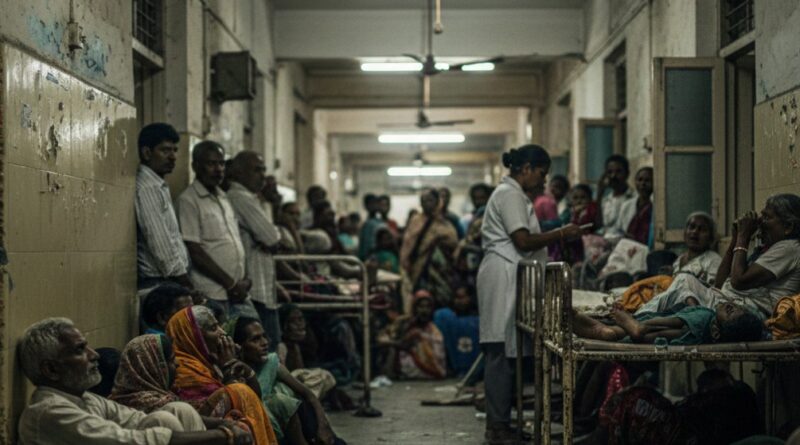
Rajasthan’s public health system still struggles for the bare minimum. Long before planning to reduce maternal and infant deaths, the blueprint for the necessities for running a hospital should be put into action. Necessities like delivery rooms with nutrition, sanitation, hygiene, emergency transport, security, CCTV, and ramps. It is a common sight to see multiple pregnant patients adjusting on one bed when you walk into a government hospital, sometimes no bed at all, sometimes on the floor. Therefore, the system doesn’t get better by uploading one PDF designed by intellectuals; it starts with working on the basics.
The Paradox of Affordable Healthcare in a Polluted Environment
It doesn’t take an expert to understand that cleaner air means healthier lungs, fewer illnesses, fewer hospital visits, and therefore reduces the healthcare expenditure. The Government of Rajasthan wants to cut out-of-pocket treatment costs from 37% to 8% without managing the disease burden. At present, air and water pollution are becoming major contributors to disease risk factors. Air pollution in cities like Jaipur, Kota, Jodhpur, and Alwar is alarmingly high.
It is not a hidden fact that from our lungs to metabolism, our whole body has become prone to the permanent damage caused by poor air quality. Meanwhile, lower food standards in India remain an unacknowledged hidden factor in population health outcomes. Several other never-ending factors can be controlled by strict government policies targeting a sustainable environment and stricter implementation. The government has to realize that reducing risk will increase healthy life years by itself.
The Fancy AI-Powered Diagnosis
AI diagnostic technology helps doctors in prompting the treatment of a large population, but when it is not managed well, it can be the cause of chronic suffering in that population. There is no doubt that artificial intelligence is a very supportive tool in healthcare, but it cannot control the chronic dust particles, industrial waste polluting the water bodies, vector-borne diseases. Therefore, until the cause is managed well, no system will be able to perform at its maximum capacity.
Planning Medical Tourism While Local Healthcare Struggles
The vision includes promoting medical tourism. Medical tourism involves world-class healthcare infrastructure. In India, it’s most common in private hospitals. Treatment in such hospitals costs a fortune. Rajasthan’s healthcare infrastructure, hospitals, and doctors per capita fall short of the local need, yet the government is curious to bring more people in to at least earn a big chunk of money from foreign patients.
The Promise vs Reality
Increasing life expectancy on paper is something any health department can promise. But when the root causes of the problem you are trying to solve are avoided, then it will only result in more questions from the public in 2047. Investment in medical colleges, diagnostic tools, and better infrastructure is the immediate need of the hour. People pay more than enough taxes in this country to deserve a world-class healthcare system rooted in a strong, accessible, and affordable foundation. This raises an important question: Is this impressive health initiative really just a clever way to draw in investment and tourists, all while hiding the underlying neglect of ecological and social factors that impact health?