Crop Protection Industry Flags Safety Risks in Unregulated Online Pesticide Sales
CropLife India calls for stronger oversight of e-commerce platforms amid regulatory gaps in digital agri-input supply chains
New Delhi, January 21, 2026 – India’s crop protection industry has raised the alarm over the growing sale of unauthorised pesticides through e-commerce platforms, warning that current regulations are failing to keep pace with the rapid digitisation of agricultural supply chains.
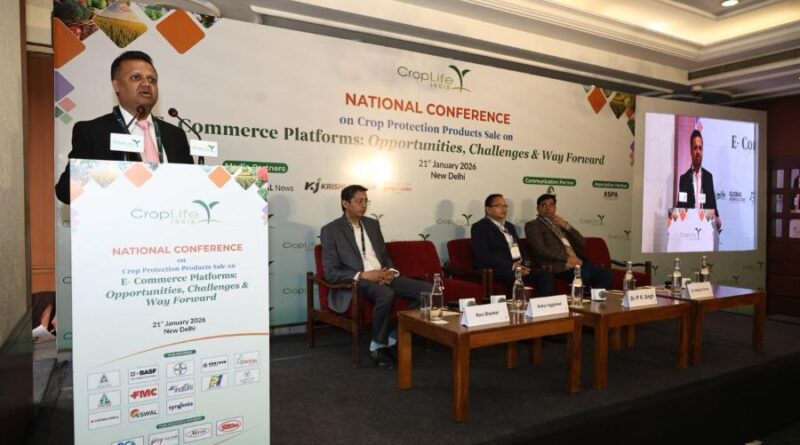
CropLife India, representing 17 research-driven crop protection companies that account for roughly 70% of the market, convened a national conference in the capital today to address what it describes as critical gaps in how pesticides are sold online. The gathering brought together senior government officials, regulators, industry leaders and other stakeholders to examine emerging risks to farmer safety and product integrity.
Dr. P.K. Singh, Agriculture Commissioner at the Ministry of Agriculture and Farmers Welfare, told the conference that basic compliance measures such as verifying sellers’ GST documents are inadequate when dealing with hazardous agricultural inputs. He called for enhanced quality assurance, traceability and accountability mechanisms that could be incorporated into the upcoming Pesticides Management Bill, 2025.
The core concern centres on a regulatory framework that hasn’t caught up with digital commerce. Under the Insecticides Act, 1968 and its accompanying rules, pesticides can only be sold by licensed dealers operating within approved geographic areas and handling specific products listed on their licences. Each sale must be backed by a valid Principal Certificate from the manufacturer or importer.
However, e-commerce platforms facilitating pesticide sales currently face no requirement to obtain licences under pesticide law, nor do they have explicit obligations to verify that listed products are properly authorised. This creates what the industry describes as a significant oversight gap.
The situation is particularly acute in inventory-based e-commerce models, where pesticides may be stored and dispatched from unlicensed warehouses – a practice that would require licensing in traditional offline sales. This undermines regulatory supervision and makes product sampling, inspection and traceability considerably more challenging for authorities.
CropLife India clarified that Rule 10E, introduced in 2022 to permit online or doorstep delivery of pesticides, has in some instances been misinterpreted as removing the need for standard licensing and authorisation requirements. The association stressed that this provision was meant to enable delivery methods, not to dilute existing safeguards.
Dr. Subhash Chand, Secretary of the Central Insecticides Board and Registration Committee, acknowledged that while digitisation is expanding rapidly in rural India, it brings new risks. He emphasised that responsibility for quality, compliance and farmer safety must be shared between platforms and manufacturers as online sales grow.
Ravi Shankar, Domain Lead for Agriculture at the Open Network for Digital Commerce, highlighted the need for improved product cataloguing, advisory information and traceability systems to help farmers distinguish genuine products from spurious ones.
Ankur Aggarwal, Chairman of CropLife India, was careful to position the industry’s concerns as supportive rather than oppositional to online sales. “We are not against the sale of pesticides on e-commerce platforms,” he said. “This engagement is about ensuring that regulatory and enforcement frameworks evolve with the realities of digital commerce.”
He added that while the Draft Pesticides Management Bill, 2025 aims to strengthen India’s regulatory framework, it doesn’t explicitly address platform-level accountability, licensing obligations for inventory-based models, or digital traceability across online supply chains. The association plans to submit detailed recommendations through the formal consultation process.
The conference underscored a broader challenge facing agricultural regulation worldwide: how to maintain safety and quality standards as commerce shifts from physical marketplaces to digital platforms where traditional inspection and enforcement methods often prove ineffective.
For farmers, the stakes are high. Unauthorised or counterfeit pesticides can damage crops, pose health risks and undermine food security. For the legitimate crop protection industry, unchecked online sales erode consumer trust and create unfair competition.
CropLife India, whose members invest approximately $6 billion annually in global research and development, has called for what it terms “regulated enablement” – a framework that allows digital commerce to flourish while preserving essential safeguards.
As India’s agricultural sector continues its digital transformation, the industry’s appeal suggests that policymakers face mounting pressure to update regulations designed for an era of physical storefronts to address the realities of app-based commerce and warehouse fulfilment networks.