GULF ON FIRE: Iran’s Missiles and Drones Rain Down on Kuwait, UAE and Qatar as Trump’s Hormuz Ultimatum Looms and Oil Hits Crisis Levels
Week six of the US-Israel war on Iran sees drone strikes on Gulf infrastructure, a 48-hour ultimatum over the Strait of Hormuz, Easter Masses cancelled in Dubai, and oil markets teetering on the edge of $200 a barrel
April 5, 2026 | Special Report
THE BIG PICTURE
Thirty-seven days into one of the most consequential military conflicts since World War II, the US-Israel war on Iran shows no sign of abating — and its shockwaves are now reshaping daily life from the mountains of western Iran to the skyscrapers of Dubai, the gas terminals of Qatar, and the oil refineries of Kuwait. As President Trump’s 48-hour ultimatum over the Strait of Hormuz counts down and Tehran fires back with defiance, the world is watching a crisis that has already become, in the words of one senior energy official, the greatest global energy security challenge in history.
IRAN REJECTS TRUMP’S HORMUZ ULTIMATUM
Iran’s central military command formally rejected President Trump’s threat to destroy the country’s vital infrastructure if it does not reopen the Strait of Hormuz within 48 hours. Trump had warned that “all hell will rain down” on Iran if the waterway — through which a fifth of the world’s oil flows — remains blocked by Monday.
An Iranian general dismissed the ultimatum as “helpless and stupid,” mirroring the defiant tone Tehran has maintained throughout the conflict. Iran’s Foreign Minister Abbas Araghchi left a narrow diplomatic door ajar, saying Tehran had not refused to go to Islamabad for talks, but that what mattered were the terms for a conclusive and lasting end to what he called the illegal war being imposed on Iran.
According to mediators cited by the Wall Street Journal, Iran has made stringent conditions for ending hostilities — including reparations, a full withdrawal of US military forces from the Middle East, and guarantees against future attacks — making any ceasefire framework extremely difficult to reach under current conditions. Mediators from Turkey and Cairo are reportedly considering alternative venues including Doha and Istanbul for fresh proposals.
KUWAIT BATTERED: DRONES HIT POWER PLANTS, MINISTRY BUILDINGS AND OIL FACILITIES
Kuwait is absorbing some of the heaviest blows of the conflict’s latest phase.
Kuwait’s Ministry of Electricity confirmed that Iranian drones struck two power and water desalination plants overnight, resulting in significant material damage and the shutdown of two electricity generating units, though no casualties were reported. The country’s Ministries Complex building in Kuwait City was also hit by a drone on Saturday evening, causing significant structural damage.
Kuwait’s Defence Ministry said it had dealt with eight missile and 19 drone attacks in the past 24 hours alone, with the army confirming its air defences were actively intercepting hostile attacks across the country.
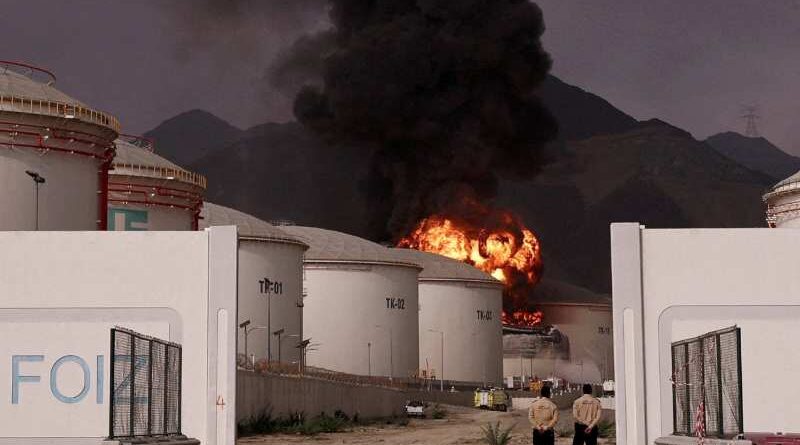
Earlier, Kuwait’s Petroleum Corporation reported that multiple units at Mina Al-Ahmadi — the country’s largest oil refinery — caught fire following a drone strike. Emergency teams worked to contain the blaze and no injuries were reported.
UAE AND BAHRAIN UNDER SIEGE
The United Arab Emirates reported that its air defence systems engaged 23 ballistic missiles and 56 drones launched from Iran. The Abu Dhabi government confirmed that 12 people were wounded — including a Nepali national who sustained a major injury — as debris rained down in the Al Ajban area following interceptions of dozens of Iranian projectiles.
An Iranian missile and drone strike caused significant damage to the Emirates Global Aluminium site in Abu Dhabi, forcing a shutdown of the facility.
Bahrain’s Defence Force said its air defences intercepted 13 drones in the past 24 hours alone. Since the war began on February 28, Bahrain has now intercepted a cumulative total of 188 missiles and 466 drones.
Saudi Arabia’s Defence Ministry also reported intercepting and destroying around a dozen drones in the same period, even as Iran continued its sustained assault on US Gulf allies.
DUBAI AND QATAR: ECONOMIC HUBS IN PARALYSIS
The war’s economic fallout has transformed two of the world’s most visited and commercially vital cities.
All Easter Masses in Dubai were cancelled because of the war, with two Catholic churches in the UAE posting notifications on their websites informing congregants — as the region’s Christian communities marked Good Friday and Easter Sunday under the shadow of conflict.
Tourism in the UAE and Qatar has suffered severely, with hotel bookings plummeting and economic hubs like Dubai facing paralysis. According to one analysis, a prolonged conflict would spell an economic catastrophe for Gulf states.
An Amazon Web Services data centre in Dubai was damaged earlier in the conflict when shrapnel from an intercepted Iranian drone struck the facility — an incident described as potentially the first time in history that a major company’s cloud infrastructure was damaged in wartime.
Iran carried out a major strike on Ras Laffan Industrial City, Qatar’s principal site for LNG production, in retaliation for an Israeli strike on Iran’s South Pars gas field. QatarEnergy declared Force Majeure on all its export contracts, and internal sources told Reuters that gas liquefaction would soon be shut down entirely, with analysts warning it could take weeks to restart operations.
THE OIL SHOCK: BRENT AT $141, $200 IN SIGHT
The economic fallout from the conflict has sent energy markets into historic territory.
Brent crude oil’s spot price surged to $141.36 per barrel — the highest level since the 2008 financial crisis — reflecting the acute supply constraints caused by Iran’s effective blockade of the Strait of Hormuz.
US government officials and Wall Street analysts are now openly considering the possibility that prices could surge to an unprecedented $200 a barrel, as Gulf suppliers reduce production and storage in the region fills to capacity. Already, parts of the world’s largest LNG plant sustained missile damage, with QatarEnergy warning repairs could take up to five years.
The Dubai oil benchmark — used to price 18 million barrels per day and based on crude from the UAE, Oman and Qatar — is under severe stress, with market participants telling Reuters the benchmark is effectively broken, as most oil shipments have been halted due to the threat of Iranian attacks on tankers transiting the Strait.
Bloomberg Economics estimated that a simple calculation of the Strait’s closure suggests a shortfall of roughly 9 million barrels per day — a gap larger than the combined oil consumption of the UK, France, Germany, Spain and Italy.
The Gulf Cooperation Council imports the vast majority of its food — around 70% of which passes through the Strait of Hormuz. The blockade has triggered a severe food security crisis across the region, with shortages and sharp price increases reported at grocery stores across Gulf states.
ISRAEL STRIKES IRAN, IRAN STRIKES BACK
The IDF said it carried out more than 70 strikes in Iran over the past 24 hours, launching a new wave of attacks including in Tehran and Beirut.
Iran fired missiles and drones at Israel in what it described as the sixth wave of attacks on the country, with the Israeli army activating its defensive systems to intercept incoming fire. A ballistic missile landed in an open area in southern Israel, and intelligence officers assessed that Iran still possesses over 1,000 ballistic missiles despite weeks of intensive US-Israeli strikes.
US and Israeli aircraft also struck a research centre at the prestigious Shahid Beheshti University in Tehran, with Iran’s Minister of Science saying at least 30 universities have been impacted by strikes since the war began.
Russia announced it was continuing to evacuate staff from Iran’s Bushehr nuclear power plant. Nearly 200 Russian workers departed by bus just minutes before the plant was struck in the latest attack, killing one Iranian security guard.
DIPLOMACY: HOPE AND DEAD ENDS
Leaders of 40 countries convened virtually at the request of the British government to discuss diplomatic and economic measures to compel Iran to reopen the Strait of Hormuz, but the meeting ended without agreement on any specific steps. Notably, neither the US nor Israel — the two countries that launched the war — were present at the summit.
Italy’s Prime Minister Giorgia Meloni made a surprise unannounced visit to Saudi Arabia and Qatar — the first EU, G20 and NATO leader to visit the Gulf region since the war began — reaffirming the necessity of reopening the Strait of Hormuz, with Italy and much of Europe heavily dependent on energy imports from the region.
The UK announced it is deploying RapidRanger short-range drone defence systems to the Gulf, while Pakistan told the Associated Press that ceasefire brokering efforts are “right on track.”
Iran separately confirmed it would allow Iraq unrestricted passage through the Strait of Hormuz, stating the blockade applies only to “enemy countries.”
HUMAN TOLL
At least 2,076 people have been killed and 26,500 wounded in Iran since the war began on February 28. More than 600 schools and educational centres have been hit across Iran since the start of hostilities.
The human toll across the wider region continues to mount, with displaced Lebanese civilians struggling to meet basic needs as a widespread humanitarian emergency unfolds, and three UN peacekeepers wounded in southern Lebanon — the third such incident in a single week.