The Lotus Finally Blooms: BJP Conquers Bengal After 75 Years of Trying
In the most consequential state election result of 2026, Modi’s party swept Mamata Banerjee’s 15-year-old fortress — ending TMC rule and rewriting the political map of India’s eastern heartland.
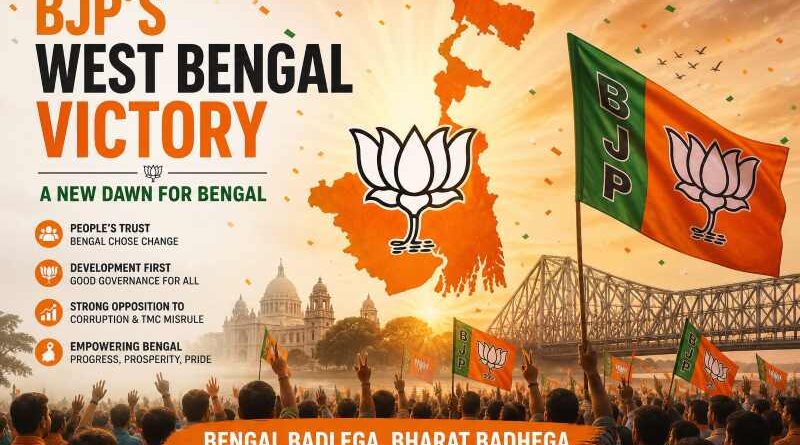
After decades of trying, the Bharatiya Janata Party has done what once seemed impossible: it has won West Bengal. The results declared on May 4, 2026 delivered a thumping majority to the BJP — more than 200 seats in a 294-seat assembly — reducing Mamata Banerjee’s Trinamool Congress to a distant second with just 87 seats. The majority mark was 148. The swing was not just an election win. It was a political earthquake.
BJP’s previous best in Bengal was 77 seats in 2021. In a single election cycle, it more than doubled that haul. Mamata Banerjee, the three-time chief minister who has dominated Bengal’s politics since 2011, not only lost power — she lost her own seat of Bhabanipur to BJP’s Suvendu Adhikari, by a margin of around 15,000 votes. It was the second time Adhikari had defeated her personally. A record 92.93 per cent of voters — nearly 68.2 million people — turned out to cast their ballots.
THE NUMBERS
BJP: 200+ seats TMC: 87 seats Majority mark: 148 / 294 total seats
BJP’s seat share: approximately 68 per cent TMC’s seat share: approximately 30 per cent
WHAT BJP’S VOICES SAID
Prime Minister Narendra Modi, posting on X on May 4, wrote:
“The Lotus has bloomed in West Bengal! The 2026 West Bengal Assembly elections will be remembered forever. The power of the people has triumphed, and the BJP’s politics of good governance has emerged victorious. I bow down to every single citizen of Bengal.”
He added: “The people have given the BJP a magnificent mandate, and I assure them that our party will make every possible effort to fulfil the dreams and aspirations of the people of West Bengal. We will provide a government that ensures opportunities and dignity for all sections of society.”
BJP leader Suvendu Adhikari, who defeated Mamata twice and is widely expected to be in contention for Chief Minister, posted on X (@SuvenduWB):
“With a heart overflowing with humility and profound gratitude, I bow before the Janata-Janardan of West Bengal. Today’s historic mandate is not just a victory for the Bharatiya Janata Party; it is a resounding triumph for every Citizen, every Sanatani who dreamt of a Sonar Bangla.”
WHAT TMC AND THE OPPOSITION SAID
Mamata Banerjee, speaking to the media in the evening after the results came in, was defiant and furious:
“More than 100 seats the BJP looted. The Election Commission is the BJP’s commission. Do you think this is a victory? It is an immoral victory, not a moral victory. Whatever the Election Commission has done, along with the Central Forces and the PM and Home Minister, is totally illegal. We will bounce back.”
She also alleged that she was denied entry to the counting centre in Bhabanipur despite holding an ID card, and claimed that CCTVs were switched off and TMC polling agents were barred from counting centres.
Congress leader Rahul Gandhi backed Banerjee’s claims, posting on X:
“Assam and Bengal are clear cases of the election being stolen by the BJP with the support of the EC. We agree with Mamata ji. More than 100 seats were stolen in Bengal. We have seen this playbook before: Madhya Pradesh. Haryana. Maharashtra. Lok Sabha 2024.”
WHY BJP WON — WHAT THE ANALYSTS SAY
Political observers point to a potent mix of factors that converged to deliver this historic result.
Anti-incumbency against 15 years of TMC rule was perhaps the single most important driver. Praveen Rai, political analyst at the Centre for the Study of Developing Societies in New Delhi, noted that the TMC “failed to offer anything new to the voters” and could not overcome “growing resentment against economic deprivation and the aspirational needs of common people.” The party system, he argued, “had turned hostile towards people who did not subscribe to their ideology.”
Religious polarisation also played a defining role. The BJP ran hard on the narrative that Banerjee “appeases Muslims” — a charge she has always rejected. Many Hindu voters, including those who had long supported TMC, said they switched sides over concerns about minority appeasement and illegal infiltration from Bangladesh. BJP’s campaign, led by Modi and Home Minister Amit Shah, repeatedly attacked TMC on these themes and promised a “Sonar Bangla” — a golden Bengal — under BJP governance.
Rahul Verma, an election observer at Shiv Nadar University, said the BJP “ran a better-managed campaign this time” and noted that “without serious anti-incumbency, West Bengal would not have gotten this kind of result.”
The controversial Special Intensive Revision (SIR) of electoral rolls cast a shadow over the process. Before polling, the Election Commission removed more than nine million names — nearly 12 per cent of the state’s 76 million registered voters — from the voting list. The opposition alleged this was a targeted move to disenfranchise minority voters. The BJP and the EC denied any wrongdoing.
WHY THIS MATTERS NATIONALLY
Bengal was not just another state. It was the birthplace of Shyama Prasad Mukherjee, who founded the Bharatiya Jana Sangh — the ideological forerunner of the BJP — in 1951. Winning it carries a symbolism that goes far beyond seat arithmetic.
For Mamata Banerjee, the loss is devastating on multiple fronts. She had emerged as a key national challenger to Modi, positioning her politics as a bulwark against Hindu majoritarianism. That platform is now severely weakened. Analyst Praveen Rai told Al Jazeera that the loss also “weakens Banerjee’s hopes of emerging as a national challenger for Modi’s job.”
The national implications extend further. In the 2024 general elections, Modi’s party had fallen short of a majority, leaving it reliant on coalition partners. The Bengal win — part of a 3-2 sweep across five states on May 4, with BJP also retaining Assam and winning Puducherry — has dramatically redrawn that landscape. According to Rai, it “substantially increases the national standing of Modi’s leadership and extends the hegemonic power of the BJP to govern India.