India, Russia Sign Judicial MoU as Chief Justice Surya Kant Calls for Tech-Human Balance in Courts
The Supreme Courts of India and the Russian Federation have formalised bilateral cooperation in judicial administration, with Chief Justice Surya Kant using the Moscow platform to showcase India’s AI-driven court reforms — and to caution against machines replacing judges
By NewsArc Bureau
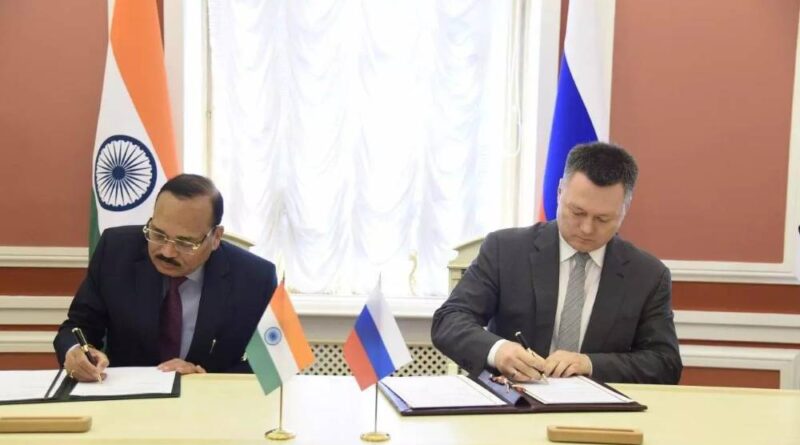
MOSCOW/NEW DELHI, June 24 — The Supreme Court of India and the Supreme Court of the Russian Federation signed a Memorandum of Understanding on judicial cooperation in Moscow on Tuesday, marking a significant step in bilateral legal ties between the two nations. Chief Justice of India Surya Kant and Chief Justice of the Russian Federation Igor Krasnov signed the agreement at the Russian apex court.
Addressing the gathering at the Supreme Court of the Russian Federation, Chief Justice Surya Kant observed that while the Indian and Russian judiciaries have evolved through distinct legal traditions, both institutions confront a shared imperative — maintaining public trust in the justice system at a time of sweeping technological and societal change.
Technology as a Bridge, Not a Replacement
Chief Justice Surya Kant outlined India’s digital transformation of the judiciary, underscoring that the guiding principle behind each initiative has been widening access to justice — not automating judicial outcomes.
He drew attention to SUVAS, the Supreme Court Vidhik Anuvaad Software, an AI-powered translation tool that converts English-language judgments into 16 regional Indian languages, significantly expanding the reach of judicial decisions to litigants across linguistic communities. He also highlighted Su Sahay, a recently launched AI chatbot designed to help litigants, lawyers, and members of the public navigate court procedures, track case status, and understand filing requirements without needing legal intermediaries.
Another initiative, “One Case, One Data,” was cited as a key step towards creating a unified, standardised digital record for every case across all judicial platforms — reducing duplication, improving transparency, and enabling more efficient case management. The Chief Justice also noted the growing deployment of technology to promote online arbitration and mediation, which he said had contributed to reduced costs and faster dispute resolution.
AI Can Assist, Not Adjudicate
Despite his enthusiasm for judicial technology, Chief Justice Surya Kant drew a firm line between the roles of machines and judges. The administration of justice, he asserted, must remain a fundamentally human endeavour.
While artificial intelligence can capably support judges in tasks such as translation, transcription, information retrieval, and administrative functions, it is constitutionally and ethically unfit to determine case outcomes, assess the credibility of witnesses, weigh evidence, or exercise judicial discretion — functions that lie at the irreducible core of adjudication.
He referenced the Supreme Court’s recently notified draft regulations on the use of artificial intelligence in the judiciary, which are designed to ensure that AI tools are deployed responsibly, preserving both judicial independence and human oversight over all consequential decisions.
A Partnership Built on Common Challenges
Chief Justice Surya Kant expressed hope that the MoU would translate into concrete, sustained engagement between the two judiciaries — including exchanges between judicial academies, joint training programmes, collaborative research, and the mutual sharing of institutional best practices.
“The future of justice will depend upon our ability to combine technological innovation with enduring human values,” he said, expressing confidence that deeper India-Russia judicial engagement would strengthen legal institutions in both countries.
The signing of the MoU comes at a moment of renewed diplomatic activity between New Delhi and Moscow, and adds a formal institutional dimension to a bilateral relationship that has traditionally been grounded in defence, energy, and trade cooperation.