From Ghallughara to Punjab ’95 to Satluj: how one film survived four years of censorship, only to vanish in two days
Explained: why Diljit Dosanjh’s Satluj was banned in India, but still streams abroad
NewsArc Bureau | New Delhi/Chandigarh
A film that took nearly four years, three titles and 127 censor cuts to reach Indian audiences lasted barely 48 hours on the platform that finally streamed it. Diljit Dosanjh’s Satluj — pulled from ZEE5’s Indian catalogue days after its July 3 release — has reopened one of Punjab’s most sensitive chapters and triggered a political and cultural storm that shows no signs of settling. Here is a complete, 360-degree look at what happened, why, and what it means.
WHAT IS SATLUJ, AND WHO IS IT ABOUT
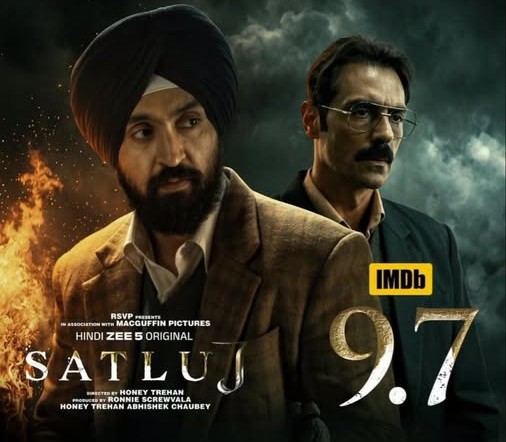
Directed by Honey Trehan and produced by Ronnie Screwvala’s RSVP in association with MacGuffin Pictures, Satluj is a biographical drama based on the life of Jaswant Singh Khalra, the Sikh human rights activist who exposed the alleged illegal mass cremation of thousands of unidentified bodies by Punjab Police during the state’s militancy years in the 1980s and 1990s.
Khalra, a bank employee who served as general secretary of the Human Rights Wing of the Shiromani Akali Dal, used municipal cremation records from Amritsar and Tarn Taran to build a case that around 25,000 people — many of them young men allegedly picked up during counter-insurgency operations — had been secretly cremated without being handed over to their families. His findings implicated the conduct of the Punjab Police under then Director General of Police K.P.S. Gill.
Khalra disappeared on September 6, 1995, allegedly abducted by Punjab Police personnel outside his Amritsar home. He was allegedly held in illegal custody, tortured at Jhabal police station, and killed, his body reportedly thrown into the Sutlej river and never recovered. After a prolonged legal battle led by his widow, Paramjit Kaur Khalra, six Punjab Police officials were eventually convicted for his abduction and murder.
The film stars Diljit Dosanjh as Khalra, alongside Arjun Rampal, Kanwaljit Singh, Suvinder Vicky and Geetika Vidya Ohlyan.
THE FOUR-YEAR CERTIFICATION BATTLE
Satluj’s journey to screens was anything but smooth. RSVP first approached the Central Board of Film Certification (CBFC) in late 2022 under the title Ghallughara — a historical term used to describe the massacres of Sikhs in 1746, 1762 and, more recently, in the context of 1984. The CBFC’s initial review process, which took roughly six months, resulted in 21 demanded cuts and an insistence that the title be changed, which is how the film came to be called Punjab ’95.
RSVP appealed the certification order in the Bombay High Court. Around the same period, the film was withdrawn from its scheduled gala premiere at the 2023 Toronto International Film Festival. After the High Court hearing, the matter was sent back to a revised CBFC committee — and this time, the demanded changes ballooned from 21 to 127.
Director Honey Trehan has said the demands went well beyond trimming violent scenes. According to Trehan, the board sought changes to the title, the removal or alteration of references to Punjab Police, changes to the names of real people depicted in the film, removal of references to specific places, deletion of shots featuring the Indian flag, and the toning down or removal of several dialogues and scenes tied directly to Khalra’s investigation.
Eventually, the makers withdrew their court petition and opted to release the film on OTT instead of in theatres — under yet another new title, Satluj, named after the river into which Khalra’s body was allegedly disposed.
THE RELEASE — AND THE TAKEDOWN
Satluj premiered quietly on ZEE5 Global on July 3, with minimal promotion. Diljit Dosanjh clarified on Instagram Live that while the makers could not retain the original title Punjab ’95, the version streaming was uncut: “There are absolutely no cuts in the film. The version I watched in theatres two years ago is exactly the same one I watched at home last week. If even a single cut had been made I would not have promoted the film.”
Dosanjh appeared to anticipate trouble. In the same live session, he told fans, “Today is Saturday. I feel it could be taken down by Monday. But no worries, you download it.” He also said he was surprised the film had made it to OTT at all.
His prediction proved accurate, and swifter than even he expected. On July 5 — Sunday evening, roughly 48 hours after release — ZEE5 removed Satluj from its Indian catalogue. In a statement posted to its official Instagram account, the platform said: “The response to Satluj since its release has been truly overwhelming. We are deeply grateful to every viewer who chose to subscribe, watch and champion the film… In light of the current developments, Satluj will be unavailable in India until further notice. We remain committed to exploring every appropriate avenue through due process to bring the film back to our audiences at the earliest opportunity.”
The film remains available internationally on ZEE5 Global.
WHO ORDERED THE TAKEDOWN, AND WHY
ZEE5’s own statement did not specify a reason beyond vague reference to “current developments.” However, according to reports, the Ministry of Information and Broadcasting directed the platform to remove the film, citing security concerns under the Information Technology Rules, 2021 — the framework that governs OTT content, distinct from the CBFC certification process that applies to theatrical releases.
Officials reportedly said the version released on ZEE5 had not incorporated the changes sought during the earlier certification process — effectively releasing what the CBFC had, in effect, never cleared, since the makers had withdrawn from that process rather than complete it.
A spokesperson for RSVP Movies told The Indian Express that the film was removed on government orders. The government has not issued a detailed public statement explaining the decision, and requests for comment to the federal information and broadcasting ministry have gone unanswered so far.
DILJIT DOSANJH’S REACTION
Dosanjh addressed the removal directly in a live video, saying the timing — rather than the takedown itself — had caught him off guard: “My love and respect to all of you. What I had already expected is exactly what happened. I thought the film might get banned when [government] offices opened on Monday, but I didn’t know it would happen as early as Sunday evening.”
He has since drawn a pointed parallel between the film’s fate and that of its subject, telling media that Satluj “suffered the same fate as Jaswant Singh Khalra” — a reference to Khalra’s own silencing decades earlier. In an interview with Variety India, Dosanjh also spoke about the personal toll of the role: “After this film, I had to take a week off to process everything that I went through portraying Jaswant Singh Khalra.”
POLITICAL AND RELIGIOUS FALLOUT IN PUNJAB
The removal has reignited long-standing debates over Punjab’s militancy years and reopened political fault lines ahead of the state’s 2027 Assembly election.
The Shiromani Gurdwara Parbandhak Committee (SGPC) and the Shiromani Akali Dal (SAD) have condemned the takedown, arguing that Khalra’s work is an inseparable part of Punjab’s history and that removing the film discourages public discussion of unresolved questions from the insurgency era.
Punjab’s ruling Aam Aadmi Party has also questioned the decision, while the Bharatiya Janata Party has denied acting for political reasons, with government sources maintaining the move was purely a legal one grounded in security considerations under IT Rules rather than any attempt to suppress the film’s content or message.
Commentators have noted that the episode taps into deeper, long-running tensions in Punjab politics — questions of identity, Centre-state relations, and how the state’s militancy-era violence should be remembered — that sit alongside more immediate concerns like agriculture, employment and drug abuse ahead of the 2027 polls.
CRITICAL RECEPTION AND THE DOUBLE-STANDARD DEBATE
Despite its brief availability, Satluj drew strong reviews before its removal. The Hollywood Reporter described it as one of the finest Indian films of the year.
The takedown has also fuelled a broader debate about consistency in India’s content regulation. Critics have pointed to ZEE5’s continued hosting of other politically charged films — including The Kashmir Files (2022), The Kerala Story (2023), The Bengal Files (2025) and The Kerala Story 2 — asking why those titles remain freely available while Satluj was pulled within two days. Supporters of the removal have pushed back, with some commentators framing the film’s content as glorifying violence rather than documenting human rights abuses, arguing this justifies its restriction under security provisions.
WHERE THINGS STAND
As things stand, Satluj remains unavailable to Indian audiences on ZEE5, with the platform saying it is “exploring every appropriate avenue through due process” to restore access. The film continues to stream internationally on ZEE5 Global. No formal legal order or detailed government explanation has been made public, and neither RSVP nor the Ministry of Information and Broadcasting has indicated a timeline for resolution.
The controversy has, in the meantime, achieved something censorship battles often inadvertently do: it has pushed Jaswant Singh Khalra’s story, and the questions it raises about Punjab’s militancy years, back into national conversation — three decades after his disappearance.