Beyond Dynasties: A Journalist’s Deep Dive Into How The BJP Rewrote North India’s Political DNA
Sushil Manav’s richly documented account maps the BJP’s remarkable transformation from political outsider to dominant force across Haryana, UP, Delhi, Punjab, and Uttarakhand — balancing electoral triumph with uncomfortable truths
Parul
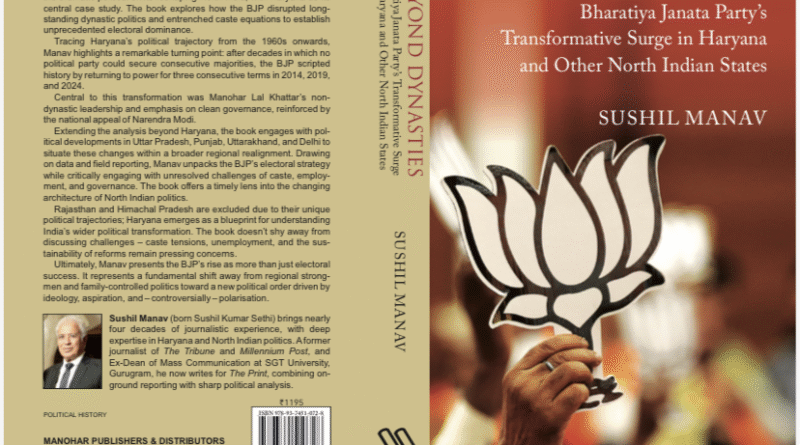
Book: Beyond Dynasties: Bharatiya Janata Party’s Transformative Surge in Haryana and Other North Indian States Author: Sushil Manav Publisher: Manohar Publishers & Distributors, New Delhi Year: 2026 Pages: 330+ | Genre: Political Non-Fiction
North India’s political landscape has undergone nothing short of a seismic transformation over the past decade. For generations, power in states like Haryana, Uttar Pradesh, Punjab, and Uttarakhand was a family inheritance — passed down through bloodlines, guarded by caste arithmetic, and lubricated by patronage rather than performance. Into this entrenched world walked the Bharatiya Janata Party, dismantling what seemed like permanent political dynasties with a mix of ideological conviction, grassroots organisation, and often controversial governance. In Beyond Dynasties, veteran journalist Sushil Manav offers perhaps the most comprehensive chronicle yet of this political upheaval — and he does so with the rare credibility of a man who watched it unfold from the ground, notebook in hand, across nearly four decades of reporting.
The Author’s Vantage Point
What distinguishes this book from partisan political commentary is the weight of Manav’s credentials as a working journalist. Having reported for The Tribune, Millennium Post, and The Print across Haryana, Punjab, and beyond, and having served as Dean of Mass Communication at SGT University in Gurugram, Manav writes not as an ideologue but as a careful chronicler. The book is peppered with encounters from his years on the road — a rickshaw puller’s son who became an HCS officer through merit-based recruitment; a young woman teacher in Saharanpur who secured her job not through caste connections but on the strength of her qualifications; a trader in Ludhiana praising the simplification of tax procedures. These are the real voices of change, and they give Beyond Dynasties a human texture that purely academic analyses often lack.
Breaking the Dynastic Mould
The centrepiece of Manav’s argument is Haryana — a state where, for nearly five decades after its formation in 1966, power rotated almost exclusively among three dominant Jat families: the Devi Lals, the Bansi Lals, and the Bhajan Lals. Between them, Jat leaders occupied the Chief Minister’s chair for over 36 of Haryana’s first 48 years. This wasn’t merely electoral dominance; it was a total capture of state machinery — recruitment, contracts, land use permissions, and even the truck unions that controlled freight across the state.
The BJP’s 2014 breakthrough, led by Manohar Lal Khattar — a non-Jat, a former RSS pracharak with no prior electoral experience — represented a genuine rupture with this tradition. Manav traces how Khattar’s government introduced online transfers, transparent civil service recruitment through HPSC and HSSC, the Parivar Pehchan Patra for welfare delivery, and digital grievance mechanisms. These reforms, however incremental, gave first-generation government servants from ordinary households a foot in the door that had previously been barricaded by caste and connection. The BJP’s subsequent 2024 victory under Nayab Singh Saini — another OBC leader who defied fierce anti-incumbency and the aftershocks of the farmers’ protests to win 48 seats — is presented as confirmation that this transformation has taken root.
A Pan-North India Canvas
Manav admirably widens his lens beyond Haryana. The chapters on Uttar Pradesh trace how Yogi Adityanath’s governance disrupted the SP-BSP duopoly that had divided the state along Yadav-Muslim and Dalit lines for a generation. The author documents the BJP’s deliberate social engineering — weaving together non-Yadav OBCs, non-Jatav Dalits, and upper castes into a formidable electoral coalition — and acknowledges both its developmental achievements and its more troubling aspects, including the controversies around encounter killings and allegations of communal polarisation.
The Uttarakhand chapters offer a fascinating sub-plot: a young Himalayan state where Congress’s internal chaos and corruption scandals created a vacuum that the BJP filled decisively in 2017 with a sweep of 57 out of 70 seats. The Char Dham infrastructure project and the Uniform Civil Code are presented as milestones, though Manav is careful to note environmental criticism and the concerns of tribal communities whose customary laws may be overridden.
The Punjab analysis is arguably the most nuanced section of the book. Here, Manav acknowledges that the BJP’s electoral results in seat count have remained modest, but argues that the surge in vote share — nearly doubling between the 2019 and 2024 Lok Sabha elections — signals a structural shift in urban Hindu and trader communities. The decline of the Badal clan’s SAD, once the dominant force among Jatt Sikhs, is presented as a significant political realignment, with the Badal family’s history of promoting private interests over public services — from preferential treatment of their aviation business to the corrosion of Punjab Roadways — having finally caught up with them at the ballot box.
Balanced, But Unflinching
One of the book’s greatest strengths is its refusal to become a hagiography. Manav is equally willing to document the BJP’s failures and fault lines. Khattar’s property ID system, intended to modernise records, is described as having enabled widespread corruption and citizen frustration. E-tendering policies alienated sarpanches across Haryana. The farmers’ protests of 2020–21 exposed the depth of rural alienation that any government serving primarily non-farming communities would face in an agrarian state. In UP, the author is candid about the limitations of e-governance when systemic corruption requires far deeper remedies than digital portals can provide. In Uttarakhand, the Chamoli glacial disaster exposed gaps in disaster preparedness that infrastructure spending had failed to address.
This balance is what makes Beyond Dynasties a reliable reference rather than a political pamphlet. Manav quotes Lokniti-CSDS survey data alongside personal interviews, weaves electoral statistics with street-level anecdotes, and consistently places the BJP’s achievements in the context of what came before — giving the reader the tools to make their own judgement.
Where The Book Could Go Further
If there is a criticism to be made, it is that the book’s sheer breadth — covering five states across multiple election cycles and governance dimensions — occasionally makes it feel more encyclopaedic than analytical. Readers seeking a tighter theoretical framework for understanding why the BJP succeeded where others failed may find themselves wanting a more explicit conclusion. The final chapters on comparative analysis and the road ahead, while useful, feel somewhat compressed compared to the richness of the state-by-state narratives that precede them. The Punjab and Delhi sections, in particular, feel relatively brief given how politically significant both states are.
Verdict
Beyond Dynasties is an indispensable addition to the literature on contemporary Indian politics. Sushil Manav has produced a work that is simultaneously a journalist’s record, a historian’s survey, and a citizen’s inquiry into what Indian democracy looks like when it finally begins to break free from the grip of hereditary power. Its greatest achievement is that it holds both the promise and the peril of that transformation in plain view — neither celebrating uncritically nor condemning reflexively.
For students of Indian politics, researchers, journalists, and anyone seeking to understand how north India voted, governed, and changed in the decade between 2014 and 2024, this book is essential reading.
Rating: ⭐⭐⭐⭐ (4/5)
Beyond Dynasties is published by Manohar Publishers & Distributors, New Delhi, 2026.