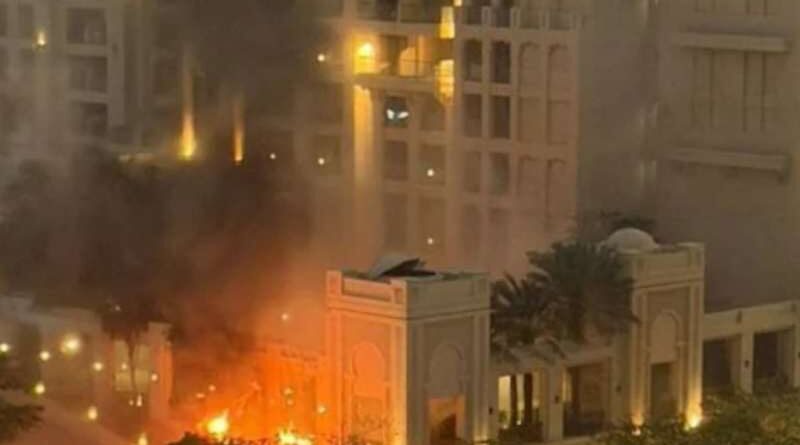
BOMBS OVER TEHRAN: THE US AND ISRAEL STRIKE IRAN TO STOP THE BOMB
What you need to know about the biggest military escalation in the Middle East in decades — and what happens next
In the early hours of Saturday, 28 February 2026, the United States and Israel launched a sweeping joint military operation against Iran, codenamed Operation Epic Fury. Explosions were reported across Tehran and air raid sirens sounded across Israel as a conflict many had feared for years became reality.
What triggered the strikes?
Trump claimed Iran was rebuilding its nuclear programme ahead of the attack, though the International Atomic Energy Agency and nuclear experts have said there is no evidence Iran resumed uranium enrichment. For months, the US had assembled a vast naval and air force presence in the region, publicly pressing Tehran to accept a new nuclear deal. When diplomacy stalled, the military option was activated.
What are the stated goals?
US President Donald Trump said the joint attacks were aimed at “eliminating imminent threats from the Iranian regime,” while Prime Minister Netanyahu said the goal was to “remove the existential threat posed by the terrorist regime in Iran.” Trump went further, calling on the Iranian people to “take over your government” once the bombing ends — a clear signal that regime change is an objective, at least rhetorically.
What has been hit?
Iran’s Foreign Ministry said the attacks targeted military and defence sites as well as civilian infrastructure across various cities. Multiple areas of Tehran were struck, including near the offices of Supreme Leader Khamenei, who was transferred to a secure location. Targets were also struck in western Iran and in the southern Hormozgan province.
How has Iran responded?
Swiftly and broadly. Iran’s Fars News Agency confirmed the country carried out attacks targeting military bases in Gulf Arab states hosting US assets, including Al Udeid Air Base in Qatar and the US Navy’s 5th Fleet headquarters in Bahrain. Missiles were also fired toward Israel. A senior Iranian official told Al Jazeera that “all American and Israeli assets and interests in the Middle East have become a legitimate target” and that “there are no red lines after this aggression.”
What’s the wider regional impact?
The conflict has rapidly destabilised the broader Middle East. At least eight countries, including Iran, Israel, Jordan and Qatar, have shut their airspace, severely disrupting global air travel. The UAE reported civilian casualties from intercepted Iranian missiles. Israel declared a 48-hour state of emergency and hospitals began moving operations to underground compounds.
What happens next?
A person briefed on the operation told NPR it was expected to last a few days, with Israel’s military focusing on Iran’s missile programme. But Iran has promised a “crushing” retaliation, and military analysts warn that toppling a government through air power alone is extremely difficult. The world is watching to see whether this escalates into a broader regional — or even global — conflict.
This is a fast-moving situation. Follow live updates from major news outlets for the latest developments.