Diplomatic Ice Breaks: Jaishankar-Sadiq Handshake Sparks Debate
Pakistan’s National Assembly Speaker claims Indian External Affairs Minister initiated first high-level contact since May military confrontation at Khaleda Zia’s funeral in Dhaka
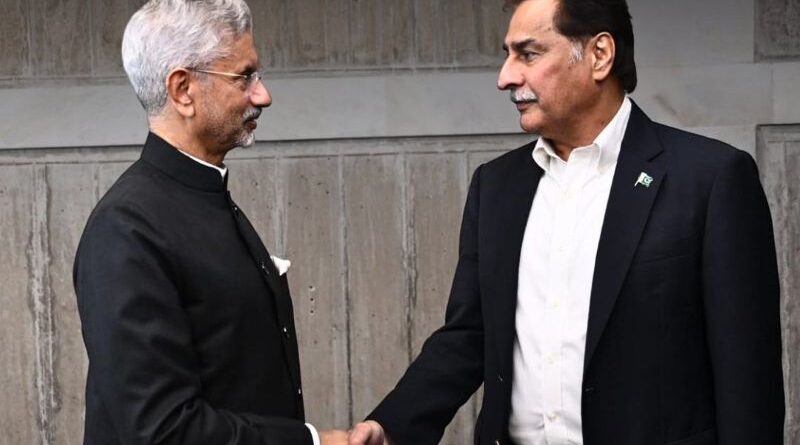
DHAKA/NEW DELHI, January 2, 2026 — A brief handshake between Indian External Affairs Minister S Jaishankar and Pakistan’s National Assembly Speaker Sardar Ayaz Sadiq in Dhaka on December 31 has prompted debate on whether the two nuclear-armed neighbors might restart dialogue in 2026.
The encounter took place during the funeral of former Bangladesh Prime Minister Khaleda Zia, marking the first visible high-level contact between Indian and Pakistani officials since their four-day military conflict in May 2025.
Pakistan’s Account: “He Recognized Me”
According to Sadiq’s account, Jaishankar walked over to him in a waiting room at Bangladesh’s parliament and shook his hand in the presence of diplomats from several South Asian countries. Speaking to a Pakistani news channel, Sadiq recounted the interaction in detail.
“He walked up to me and said hello, at which I stood up, and he introduced himself and shook hands with a smile. As I was about to introduce myself, he said, ‘Excellency, I recognise who you are and no need to introduce yourself,'” Sadiq stated.
The Pakistani politician emphasized that Jaishankar appeared deliberate in his actions. Sadiq claimed that when Jaishankar entered the room, he greeted other delegates from Nepal, Bhutan and the Maldives before deliberately approaching him and initiating a handshake.
India’s Response: “Laughable” Claims
India has not issued any official statement regarding the interaction. However, former Indian diplomat Suresh K Goel called the Pakistani reports “laughable,” stating that Pakistani ministers “stalk Indian leaders” and whenever they see an Indian leader, they immediately jump hoping to change things.
Indian sources have characterized Pakistan’s attempt to amplify what was described as a courtesy handshake as showing desperation in Pakistan’s top leadership.
Context: Strained Relations
Relations between the nuclear-armed neighbors have deteriorated for years and plunged further in April 2025 after an attack in Pahalgam in Indian-administered Kashmir, when gunmen killed 26 civilians. India blamed Pakistan for the attack and withdrew from the six-decade-old Indus Waters Treaty. Pakistan denied responsibility, but in May, the two countries engaged in an intense four-day air war.
Since that confrontation, senior officials from both countries have largely avoided public interactions, even at international forums like the United Nations.
Diplomatic Significance
While analysts caution against reading too much into the episode, noting that informal interactions at funerals and multilateral gatherings do not necessarily indicate a policy shift, they acknowledge that symbolism matters in diplomacy, particularly when relations are otherwise frozen.
Islamabad-based foreign policy analyst Mustafa Hyder Sayed called the interaction “a welcome development for the new year,” adding that basic normalcy of relations where respect is accorded to officials and hands are shaken is the bare minimum which was unfortunately absent after recent hostilities.
Pakistan’s National Assembly issued a statement emphasizing that the country has consistently advocated for dialogue, restraint, and cooperative measures, including proposals for peace talks.
What’s Next?
Whether this brief diplomatic encounter signals a potential thaw in India-Pakistan relations or remains merely a moment of protocol courtesy at a solemn international event remains to be seen. With both nations continuing to face significant bilateral challenges including cross-border terrorism accusations and territorial disputes, any path toward normalization appears complex and fraught with obstacles.
For now, the handshake in Dhaka serves as a rare moment of direct high-level contact between two countries whose relationship remains defined by deep mistrust and recurring tensions.