Haryana Celebrates Guru Teg Bahadur’s 350th Martyrdom with PM Modi’s Visit to Kurukshetra
State Government Organizes Series of Events as BJP Eyes Punjab Polls
KURUKSHETRA, November 26, 2025 – The Haryana government organized a grand celebration to commemorate the 350th Shahidi Diwas (martyrdom anniversary) of Guru Teg Bahadur, the ninth Sikh Guru, culminating in Prime Minister Narendra Modi’s visit to Kurukshetra on Tuesday, where he participated in multiple events designed to honor the revered spiritual leader.
PM Modi’s Historic Visit
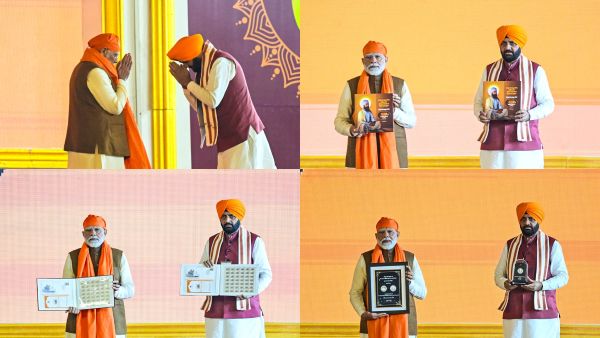
Prime Minister Modi participated in the inauguration of ‘Panchjanya’, a monument built in honor of Lord Krishna’s sacred conch, and took part in a special program commemorating the 350th Shaheedi Diwas of Guru Tegh Bahadur. During the ceremony, PM Modi and Haryana Chief Minister Nayab Singh Saini released a special commemorative coin and stamp marking the occasion.
In his address, PM Modi stated that the life and sacrifice of Guru Tegh Bahadur serve as a major inspiration, emphasizing that the guru tradition forms the foundation of the nation’s character, culture, and core spirit. The Prime Minister drew connections between India’s spiritual heritage, noting his morning visit to Ayodhya and his evening presence in Kurukshetra.
The Prime Minister’s visit also included prayers at Brahma Sarovar, one of India’s most sacred pilgrimage sites associated with the divine revelation of the Bhagavad Gita, coinciding with the ongoing International Gita Mahotsav running from November 15 to December 5.
State-Wide Celebrations Organized by Haryana Government
The Haryana government, led by Chief Minister Nayab Singh Saini, orchestrated an extensive series of events across the state to mark the historic occasion:
Educational and Cultural Initiatives: CM Saini virtually inaugurated state-level essay writing and story narration competitions titled “Suno Kahani Shri Guru Tegh Bahadur Ji Ki” from the Haryana Secretariat, with over 350,000 students from schools across the state participating in the initiative.
Four Sacred Yatras: The state organized four sacred yatras across Haryana, covering the entire state, which concluded in Kurukshetra on November 24, followed by an All-Faith Conference. A sacred yatra commenced from the holy land of Rori in Sirsa, where CM Saini performed Ardas at the historic Gurusar Rori Sahib Gurdwara.
Blood Donation Camp: Haryana Chief Minister Nayab Singh Saini inaugurated a state-level blood donation camp in Panchkula to commemorate the 350th martyrdom anniversary, with more than 800 people donating blood across 39 camps held statewide.
Infrastructure Development: PM Modi visited the Mahabharata Anubhav Kendra, an immersive experiential center featuring installations depicting significant episodes from the Mahabharata, highlighting its enduring cultural and spiritual significance.
BJP’s Punjab Strategy: Projecting CM Saini as Key Face
The elaborate celebrations take on added political significance as the BJP positions itself for the 2027 Punjab Assembly elections, with Haryana Chief Minister Nayab Singh Saini emerging as a central figure in the party’s outreach strategy.
OBC Leadership and Non-Jatt Sikh Outreach:
After its victory in Delhi, the BJP has shifted its focus to Punjab, pitching Haryana Chief Minister Nayab Singh Saini as its poster boy for the 2027 Assembly polls, with Saini being positioned to expand the party’s appeal in Punjab. An OBC face, Saini has proven instrumental in consolidating non-Jat votes for the BJP in Haryana, and the party now hopes to replicate this strategy in Punjab, targeting the state’s 38% Hindu population, a majority of whom belong to the OBC community.
Strategic Positioning:
Saini’s recent outreach efforts in areas such as Zirakpur and Dera Bassi, which have significant OBC populations, signal the party’s aggressive groundwork, with efforts to attract local leaders into the BJP fold. The party’s strategy extends beyond Hindu voters to include non-Jatt Sikh communities.
The BJP is attempting to achieve polarization of votes along caste lines, splitting the Sikh vote, with Dalits comprising nearly 35 percent of Punjab’s vote share—the maximum in any state—compared to just 18 percent of Jat voters. The party’s focus includes Mazhabi Sikhs, Ramdasia Sikhs, and other scheduled caste Sikh communities traditionally dominated by Jatt Sikh political leadership.
Cultural and Religious Outreach:
The Haryana government plans to build an ambitious Sikh museum on three acres in Kurukshetra on the lines of Virasat-e-Khalsa in Punjab’s Anandpur Sahib, with the government simultaneously working on a Guru Ravidas museum and bhawan on five acres in Kurukshetra.
Saini’s visits to Punjab, including his floral tribute to Shaheed Udham Singh in Sunam, tree-planting drives, and outreach in the Puadh belt—home to a sizeable Saini community—reveal the BJP’s intent to penetrate Punjab’s fractured political space.
Strategic Importance:
The Haryana government, in collaboration with the Haryana Sikh Gurdwara Prabandhak Committee, is commemorating the 350th martyrdom anniversary to take the Guru’s message and heritage to the masses. The emphasis on Guru Tegh Bahadur’s connection to Haryana, including his travels through Jind, Kaithal, Kurukshetra, and other districts, serves to strengthen historical and cultural ties between Haryana and Punjab.
According to a senior government functionary, the martyrdom celebrations of Guru Teg Bahadur on a grand scale are part of the socio-religious outreach of the BJP, indicating the strategic political calculations behind the elaborate commemorations.
Political Context and Future Implications
The BJP’s investment in honoring Guru Tegh Bahadur comes as the party seeks to rebuild its credibility among Sikh communities after its 2017 split with the Shiromani Akali Dal (SAD). With anti-incumbency plaguing the AAP and factionalism weakening both the Congress and the SAD, BJP strategists believe there is a real opportunity to expand the party’s influence in Punjab.
The party’s strategy involves leveraging Chief Minister Saini’s identity as an OBC leader, his administrative record in Haryana, and his symbolic value for non-Jatt Sikh and Hindu OBC communities in Punjab. The elaborate celebrations of Guru Tegh Bahadur’s martyrdom anniversary serve as both a genuine tribute to the revered Guru and a calculated political outreach ahead of the crucial 2027 Punjab Assembly elections.
The Central government is observing a year-long commemoration to honor the 350th Shaheedi Diwas of Guru Tegh Bahadur, who is revered as “Hind di Chadar” (Protector of India) for his supreme sacrifice for religious freedom and protection of humanity.