“Improving the Breed”: How RSS Chief Golwalkar Reframed a Complex Kerala Social Tradition as Brahmin Racial Superiority
A 1960 speech by M.S. Golwalkar praised the Sambandham tradition not as a nuanced matrilineal custom, but as a eugenics experiment — stripping Nair women of agency and dignity in the process
What Was Sambandham?
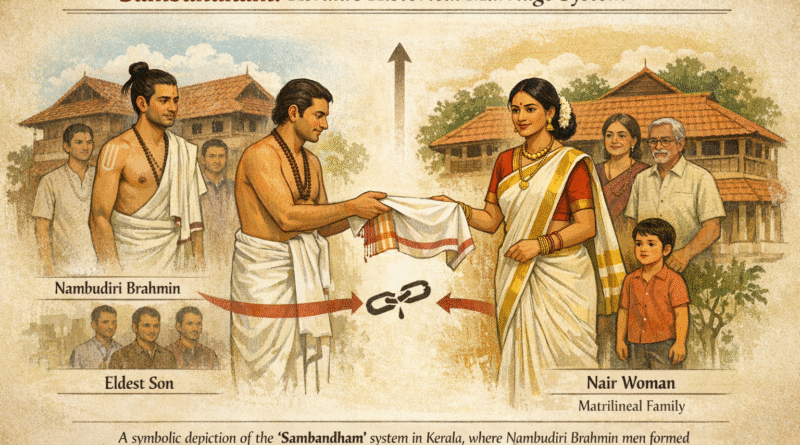
Sambandham was the traditional marriage practice observed among Nambudiris, Nairs, Samanthans, and Ambalavasis in Kerala — both within their own communities and with each other. The word derives from the Sanskrit roots meaning “equal” and “alliance.”
Kerala’s social structure was matrilineal, meaning ancestry and property passed through the mother’s line. Nair women had sambandham relationships with Brahmins and Kshatriyas, as well as with other Nairs. The arrangement was flexible: the sambandham could be broken at the will of either party, and both widows and divorced women were permitted to remarry. In a warrior society where men frequently died in battle, this offered women a measure of practical security and social continuity.
The Nambudiri Brahmin role in this system had its own internal logic. Only the eldest Nambudiri son was permitted to marry within his own community and inherit family property — a rule designed to keep ancestral land intact. Younger brothers, by custom, entered into sambandham relationships with women from Kshatriya, Ambalavasi, or elite Nair families. Children born of such relationships did not inherit their father’s property and were not accepted as members of the Brahmin community.
Historians note that the tradition has been widely misunderstood. Many have accused Nair women of practicing polyandry — having multiple husbands simultaneously — but most such accounts come from foreign visitors to Kerala in the pre-colonial era, who likely described Hindu customs in a distorted or hostile light. Sambandham was the accepted marriage custom of the matrilineal castes, and the husband — whether Nair, Nambudiri, or Ambalavasi — did not hold rights or responsibilities over the children from such marriages, as matrilineal rules made the children members of the mother’s family.
The Power Asymmetry
The relationship was not one of equals. The arrangement was hypogamous for the Nambudiri male and hypergamous for the Nair female. Crucially, Nair men were not permitted to contract a similar relationship with Nambudiri women. The traffic was strictly one-way — Brahmin men to non-Brahmin women — which reflected and reinforced the caste hierarchy rather than transcending it.
In some Nair families, the system was misused for land-grabbing. The head of the Nair household, the Karanavar, would pressure girls to enter sambandham with wealthy Nambudiris in order to extract land from them. The Nambudiri partner could be elderly while the Nair woman might be as young as twelve. The Nair Act of 1925 drew support from Nair women themselves, and by 1950, when India became a democratic republic, the practice of sambandham had effectively been eliminated. The Hindu Succession Act of 1956 then established equal inheritance rights for all Hindus regardless of matrilineal or patrilineal tradition.
Enter Golwalkar: A Tradition Recast as Eugenics
This is where the controversy sharpens considerably. M.S. Golwalkar — the second supremo of the RSS and its most influential ideologue — addressed faculty and students at the School of Social Sciences, Gujarat University, on December 17, 1960. In his address, while asserting his belief in racial theory, he described Kerala’s sambandham tradition in the following terms: “Today experiments in cross-breeding are made only on animals. But the courage to make such experiments on human beings is not shown even by the so-called modern scientist of today.”
He then went on: “In an effort to better the human species through cross-breeding, the Namboodri Brahmanas of the North were settled in Kerala and a rule was laid down that the eldest son of a Namboodri family could marry only the daughter of Vaishya, Kshatriya or Shudra communities of Kerala. Another still more courageous rule was that the first offspring of a married woman of any class must be fathered by a Namboodri Brahman, and then she could beget children by her husband. Today this experiment will be called adultery, but it was not so, as it was limited to the first child.” The speech was published in the RSS organ Organiser on January 2, 1961
Why This Statement Is Deeply Problematic
Golwalkar’s reframing of sambandham reveals several disturbing ideological threads:
1. Brahmin racial supremacy. His statement reflects a belief that North Indian Brahmins — and especially Nambudiri Brahmins — belonged to a superior race, and that this superior genetic stock was deployed to “improve” the inferior Hindus of Kerala. This is a straightforwardly eugenic argument.
2. Erasing women’s agency. Historians and critics point out that for Golwalkar, the wombs of Kerala’s Hindu women enjoyed no sanctity — they were simply objects of improving the breed through intercourse with Namboodri Brahmanas who in no way were related to them. The actual matrilineal agency that Nair women did exercise within the sambandham system is wholly absent from his account.
3. Historical inaccuracy. Golwalkar described Nambudiris as “Brahmanas of the North” settled into Kerala — a claim that scholars flag as debatable, since the origins of the Nambudiri Brahmins are historically contested. More fundamentally, the sambandham was a living social institution with its own internal logic rooted in matrilineal custom, not a top-down racial breeding programme.
4. Selective omission by the RSS. When the RSS published Golwalkar’s collected works in Hindi in 2004 under the title Shri Guruji Samagr in twelve volumes, it simply omitted the two paragraphs containing this thesis — though old copies of Organiser in libraries preserved the original text.
The Broader Context
Golwalkar’s speech sits within a wider ideological worldview. He was also on record calling for the Indian Constitution to be replaced by the Manusmriti, and praised Hitler’s treatment of Jews as a model for managing minorities in India. His racial reading of sambandham is therefore not an aberration — it is consistent with a caste-supremacist ideology dressed in cultural-nationalist language.
The irony, as critics note, is that the RSS — which presents itself as the guardian of Hindu unity and women’s honour — drew its foundational ideology from a thinker who described Kerala’s Hindu women as vessels for a Brahmin breeding experiment.