NDA Sweeps Bihar in Historic Landslide as Tejashwi Struggles to Hold Seat
Sushasan triumphs as Modi hails ‘victory of good governance’ while Opposition faces crushing defeat
PATNA, November 14, 2025 — The National Democratic Alliance (NDA) has stormed to a historic and unprecedented victory in the Bihar Assembly Elections 2025, crossing the 200-seat mark in a landslide that has stunned political observers and decimated the Opposition Mahagathbandhan’s hopes of returning to power.
As counting progressed through the day, the ruling alliance led by Chief Minister Nitish Kumar’s Janata Dal (United) and the Bharatiya Janata Party established a commanding lead across 208 constituencies in the 243-member Assembly, leaving the Mahagathbandhan trailing with a dismal showing of just 28 seats as of late afternoon trends.
The BJP emerged as the single-largest party in Bihar for the first time, leading in 96 seats out of the 101 it contested—a strike rate of over 90 percent. The JD(U) posted its best performance since 2005, leading in 84 seats compared to just 43 won in 2020. Chirag Paswan’s Lok Janshakti Party (Ram Vilas) was ahead in 19 seats, while allies Hindustani Awam Morcha and Rashtriya Lok Morcha led in 5 and 4 seats respectively.
Modi Hails ‘Sushasan’ Victory
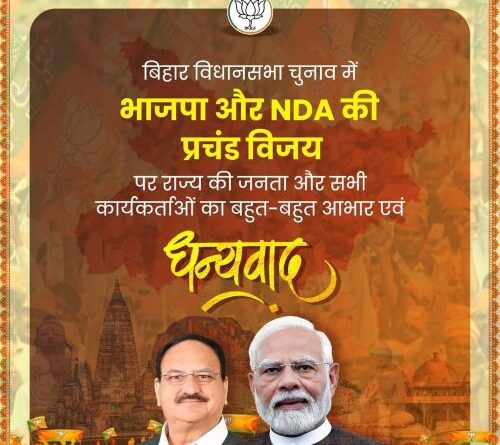
Prime Minister Narendra Modi, addressing the nation after the decisive mandate became clear, declared the result a triumph of development and governance. In a series of posts on social media platform X, the Prime Minister stated: “Sushasan ki jeet hui hai… Vikas ki jeet hui hai… Jan kalyan ki bhavna jeet hui hai… Samajik nyay ki jeet hui hai” (Good governance has won… Development has won… Pro-people spirit has won… Social justice has won).
Expressing gratitude to “the family members of Bihar,” Modi said the overwhelming mandate would empower the NDA to serve the people with renewed commitment. The Prime Minister reaffirmed his commitment to accelerating Bihar’s growth, promising to work “actively and decisively” to upgrade infrastructure, promote cultural identity, and create opportunities for youth and women.
The BJP attributed the victory to what it called a “historic transformation” in voter behaviour, with party spokesperson Pradeep Bhandari highlighting record female voter turnout as decisive. “The ‘M Factor’ — Mahila Factor — believing in development and sushasan has emerged as the real swing factor,” he stated, adding that Bihar’s political grammar had shifted from caste to “gender plus governance.”
Record Turnout Fuels NDA Wave
The elections, held in two phases on November 6 and 11, witnessed an unprecedented voter turnout of 67.13 percent—the highest since Bihar’s first Assembly polls in 1951 and nearly 10 percentage points higher than the 2020 elections. Women voters turned out in particularly large numbers, with female turnout exceeding male turnout by over 9 percentage points in the second phase.
This enthusiasm at the ballot box translated into a clear mandate for continuity. Voters appeared to reward the NDA’s emphasis on welfare schemes, infrastructure development, and law and order, while rejecting the Opposition’s promises of job guarantees and expanded social benefits.
Tejashwi’s Narrow Escape, Tej Pratap’s Humiliation
The election delivered a bitter personal blow to the family of RJD supremo Lalu Prasad Yadav. His younger son and Mahagathbandhan’s chief ministerial candidate, Tejashwi Yadav, found himself in an unexpected dogfight in the family stronghold of Raghopur, trailing for much of the day before narrowly clinging to a lead of around 1,000 votes in late counting rounds. The constituency witnessed dramatic swings throughout the day, with BJP candidate Satish Kumar mounting a strong challenge.
Far more humiliating was the performance of Tejashwi’s elder brother, Tej Pratap Yadav, who was expelled from the RJD earlier this year over personal conduct issues and contested on a ticket from his newly formed Janshakti Janata Dal. The former minister trailed badly in Mahua constituency, languishing in third place with just over 29,000 votes against LJP(RV) candidate Sanjay Kumar Singh’s commanding lead of nearly 60,000 votes—a margin of over 30,000. The crushing defeat marked a dramatic fall from grace for Tej Pratap, who had won the seat convincingly in 2015.
Bhojpuri Stars Suffer Setbacks
The election also proved disappointing for celebrities who entered the political fray. Jyoti Singh, wife of Bhojpuri power star Pawan Singh, contested as an independent candidate from Karakat after being denied tickets by major parties. Despite significant media attention, she finished a distant third with approximately 8,400 votes, trailing far behind JD(U)’s Mahabali Singh and CPI(ML)’s Arun Singh, who won the seat.
Similarly, popular Bhojpuri singer Khesari Lal Yadav, contesting on an RJD ticket from Chapra, lost to BJP’s Chhoti Kumari by a margin of over 8,000 votes, demonstrating that celebrity appeal could not overcome the NDA wave.
Key Winners and Milestones
The NDA celebrated several notable victories. Controversial strongman Anant Singh of JD(U) won from Mokama despite being jailed, defeating RJD’s Veena Devi by over 28,000 votes. BJP folk singer Maithili Thakur scored an impressive debut victory from Alinagar, leading by over 8,000 votes and celebrating by singing a traditional “badhai geet” (congratulatory song).
Deputy Chief Ministers Samrat Choudhary (BJP) and Vijay Kumar Sinha (BJP) both registered comfortable victories from their respective constituencies of Tarapur and Lakhisarai. JD(U) stalwarts including Vijay Kumar Choudhary won convincingly from their seats.
Opposition in Tatters
The Mahagathbandhan’s performance represented a catastrophic collapse from 2020, when it had won 110 seats. The RJD, which took pride in being the “single-largest party” after 2020 despite being in Opposition, was reduced to leading in fewer than 30 seats. The Congress, contesting 61 seats, managed leads in just 5 constituencies, reinforcing its reputation as “dead wood” in Bihar politics.
Prashant Kishor’s much-hyped Jan Suraaj Party, making its electoral debut, failed to open its account, with the political strategist-turned-politician unable to translate social media buzz into votes on the ground.
RJD leader and Opposition CM candidate Tejashwi Yadav put on a brave face, telling reporters: “Change will come. We are forming the government.” However, the numbers told a starkly different story as the NDA’s lead widened throughout the day.
Nitish Set for Tenth Term
The victory paves the way for 74-year-old Nitish Kumar to become Bihar’s Chief Minister for an unprecedented tenth time, cementing his status as the state’s dominant political figure since 2005 (barring a brief period in opposition). Multiple NDA leaders, including LJP(RV) MP Shambhavi Chaudhary and BJP’s Ram Kripal Yadav, confirmed that Kumar would continue as Chief Minister.
Bihar BJP chief Dilip Jaiswal attributed the victory to collective effort, stating: “The leaders of NDA have put in tremendous effort, whether it is Nitish Kumar, Chirag Paswan, Jitan Ram Manjhi, Upendra Kushwaha, PM Modi, JP Nadda, Home Minister Amit Shah or Defence Minister Rajnath Singh. We fought elections on the face of Nitish Kumar with the slogan ‘2025, phir se Nitish’.”
Analysis: Development Over Dynasty
Political analysts attributed the NDA’s sweeping victory to multiple factors: effective implementation of welfare schemes targeting women and marginalized communities, improved law and order compared to the “Jungle Raj” era, strategic caste arithmetic that neutralized traditional RJD advantages, and Prime Minister Modi’s personal appeal in Bihar.
The high voter turnout, particularly among women, appeared to favor the incumbents rather than signal anti-incumbency sentiment. The NDA’s emphasis on “sushasan” (good governance) and “vikas” (development) resonated more strongly than the Opposition’s promises of jobs and cash transfers.
The Special Intensive Revision (SIR) of electoral rolls, which removed over 6 million voters, became a point of controversy, with Samajwadi Party chief Akhilesh Yadav alleging manipulation. However, the sheer scale of the NDA victory—crossing 200 seats—suggested a genuine popular mandate rather than marginal gains from voter list revisions.
Looking Ahead
With this decisive mandate, the NDA government is expected to continue its focus on infrastructure development, women-centric welfare schemes, and industrial growth. Prime Minister Modi’s vision of “Purvodaya” (eastern India’s development) will now have renewed momentum in Bihar.
The results also carry implications beyond Bihar. The BJP’s emergence as the single-largest party shifts internal NDA dynamics, though leaders have emphasized that Kumar will continue as Chief Minister based on pre-poll agreements. The victory provides momentum to the BJP ahead of crucial elections in other states.
For the Opposition, the crushing defeat raises existential questions. The RJD must contend with leadership challenges, potential defections, and the reality that its traditional MY (Muslim-Yadav) vote bank alone cannot deliver victories. The Congress’s dismal showing reinforces its declining relevance in Bihar politics.
As celebrations erupted at BJP headquarters in Patna, with party workers distributing sweets and bursting crackers, one message emerged clearly: Bihar has decisively chosen sushasan over the politics of the past, development over dynasty, and Nitish Kumar over the Lalu Prasad family.
The final results, expected by Friday evening, will formally confirm what has become abundantly clear through the day—that the NDA has secured one of the most decisive mandates in Bihar’s electoral history, fundamentally reshaping the state’s political landscape for years to come.