Punjab Govt Unearths ₹200 Crore Tax Evasion Racket In Hospitality Sector, Total Fraud May Touch ₹500 Crore
Finance Minister Harpal Singh Cheema warns of strict action as 882 establishments come under the scanner in a sweeping, technology-driven crackdown across dhabas, restaurants, and fast-food chains
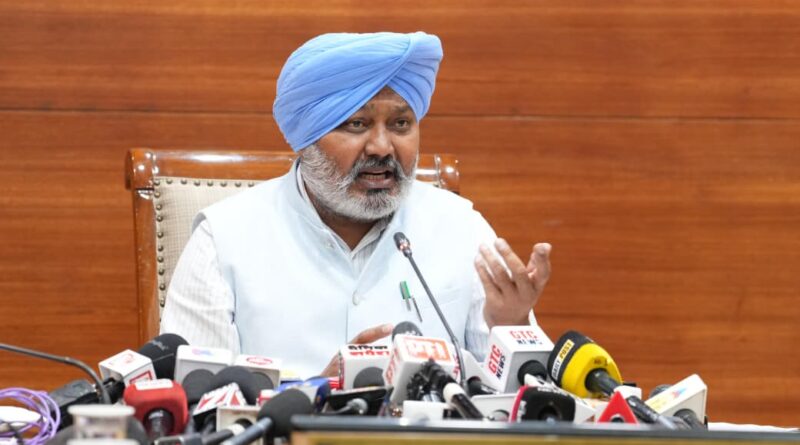
Chandigarh, March 30, 2026 — The Bhagwant Mann Government on Monday blew the lid off a massive tax evasion racket entrenched in Punjab’s hospitality sector, with Finance Minister Harpal Singh Cheema revealing that a state-wide, data-driven enforcement exercise has detected turnover suppression worth approximately ₹200 crore — a figure that could balloon to nearly ₹500 crore as investigations expand to cover earlier financial years.
Scale of the Crackdown
Addressing a press conference at Punjab Bhawan in Chandigarh, Minister Cheema disclosed that 882 establishments — spanning hotels, dhabas, eateries, bakeries, sweet shops, restaurants, and catering services — have been brought under the scanner for the financial year 2025–26. Of the 239 cases examined so far, suppression of turnover worth approximately ₹50 crore has already been detected, involving a tax liability of ₹2.54 crore at a 5% rate. The department has recovered ₹2.02 crore to date, with proceedings ongoing.
“With further analysis and the inclusion of data pertaining to financial years 2023–24 and 2024–25, the total magnitude of evasion is likely to reach approximately ₹500 crore,” Cheema warned.
Who Are The Biggest Evaders?
The investigation has revealed a striking pattern of under-reporting across taxpayer categories. Turnover suppression exceeding ₹2 crore was found in 3 taxpayers, above ₹1 crore in 6 taxpayers, above ₹50 lakh in 18 taxpayers, above ₹25 lakh in 26 taxpayers, and above ₹5 lakh in 91 taxpayers.
Sector-wise, dhabas lead the evasion list at approximately ₹10 crore, followed by small eateries, coffee and chai bars at around ₹8 crore, and pizza and fast-food outlets crossing ₹6 crore — all segments dominated by cash and hybrid payment mechanisms that make under-reporting easier to conceal.
Urban Centres In The Spotlight
Among districts, Mohali has emerged as the biggest hotspot with detected suppression of ₹8.16 crore, followed by Jalandhar at ₹6.72 crore and Ludhiana at ₹5.48 crore. Patiala and Amritsar recorded comparatively lower discrepancies at ₹3.83 crore and ₹0.99 crore respectively.
Tech-Driven Investigation
The breakthrough has been largely attributed to the Tax Intelligence Unit (TIU), the State Investigation and Preventive Unit (SIPU), and the popular citizen-engagement initiative ‘Bill Liyao, Inam Pao’ — a scheme that incentivises customers to demand bills from establishments, cutting off a key channel of revenue concealment.
The department identified that many establishments were using online billing applications, which enabled authorities to direct digital platforms to furnish detailed transactional data. This was then cross-referenced with GST returns for on-ground reconciliation. “No discrepancy has been observed in 52 establishments, reflecting balanced enforcement,” Cheema noted, underscoring that the drive is data-led and targeted, not indiscriminate.
What Comes Next
The Minister announced that the entire verification and recovery exercise is expected to be completed within one month. The department is additionally in the process of procuring UPI transaction data and other digital payment trails to deepen reconciliation of actual receipts against reported turnover.
Issuing a stern warning, Cheema declared, “Strict action shall be taken in all cases of tax evasion, while compliant taxpayers shall continue to be facilitated. The Bhagwant Mann Government is committed to leveraging technology, data analytics, and coordinated field enforcement to safeguard State revenue.”
This crackdown marks one of the largest enforcement drives in Punjab’s hospitality sector in recent memory and signals the AAP government’s intent to close revenue leakages ahead of the next budget cycle.