Punjab Wins Relief: Centre Agrees to Run Special Trains to Lift 155 Lakh Metric Tonnes of Foodgrains as Bhagwant Mann Presses Delhi on Farmers’ Crisis
CM Bhagwant Singh Mann secures a key concession from Union Food Minister Pralhad Joshi on the eve of the Rabi Marketing Season, but structural issues — Rs 9,000 crore in withheld RDF funds, unfair interest rates, hailstorm damage, and unpaid arhtiya commissions — remain unresolved and demand urgent central action
NEW DELHI / CHANDIGARH, APRIL 10, 2026
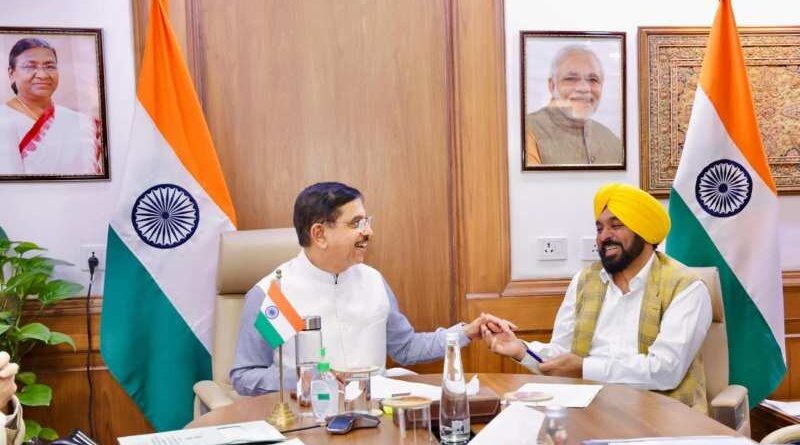
Punjab Chief Minister Bhagwant Singh Mann travelled to New Delhi on Thursday and held a wide-ranging meeting with Union Food and Public Distribution Minister Pralhad Joshi, emerging with a significant immediate concession: the Centre has agreed to run special trains to lift 155 lakh metric tonnes of foodgrains — rice and wheat — currently lying in Food Corporation of India godowns across Punjab. The move is intended to ease an acute storage crisis that threatens to derail the Rabi Marketing Season 2026-27, which has already begun in the state from April 1.
The storage situation in Punjab has reached a critical point. According to figures placed before the Union Minister by CM Mann, covered godowns in the state already hold 180.88 lakh metric tonnes of foodgrains — 151.20 LMT of rice and 29.67 LMT of wheat — against a total available covered storage capacity of approximately 183 LMT. That leaves just 0.50 LMT of covered space available for rice and 1.75 LMT of silo space for wheat. With procurement of 130 to 132 LMT of wheat expected this season, the arithmetic of storage leaves almost no room for error.
The problem has been building for months. CM Mann told the Union Minister that despite repeated requests, the average monthly movement of foodgrains out of Punjab has been only about 5 lakh metric tonnes for both wheat and rice combined — less than half of what the state considers the minimum necessary. He urged that at least 12 lakh metric tonnes each of wheat and rice be moved every month, and additionally suggested that enhanced distribution under the Pradhan Mantri Garib Kalyan Anna Yojana — similar to what was done during the COVID-19 pandemic — be considered, particularly given the hardships faced by the general public amid the ongoing conflict in West Asia.
The storage crisis is compounded by the fact that out of last year’s wheat stock of 38 LMT, approximately 8.71 LMT is already lying in CAP or open storage — scientifically suboptimal conditions — with around 40 LMT likely to face the same fate if urgent action is not taken.
Beyond the immediate storage emergency, CM Mann pressed hard on a series of structural financial grievances that have been festering between Punjab and the Centre for years.
On the Cash Credit Limit, the Chief Minister pointed out that the State Bank of India — which leads the consortium of banks authorised by the Reserve Bank of India to arrange procurement funds — charges an interest rate 0.5 percent higher than the rate applicable to the Food Corporation of India, and compounds it on a monthly basis. However, provisional cost sheets issued by the Government of India allow Punjab only simple interest at FCI’s rate. The result, Mann stated, is an avoidable loss of approximately Rs 500 crore to Punjab every single season. He demanded that Punjab be allowed to claim interest charges on a monthly compounding basis at the SBI rate, bringing it on par with FCI’s treatment.
On the Rural Development Fund, Mann disclosed that Punjab is owed Rs 9,000 crore in pending dues — money that was originally intended for constructing and modernising mandi roads and infrastructure. The funds were withheld by the Centre after the previous Captain Amarinder Singh government misused them for other purposes. The current Punjab government has gone to the Supreme Court on the matter, which is now sub judice, but Mann argued that prolonging litigation serves no one. He urged the Centre to release the dues — in instalments if necessary — since the money legitimately belongs to Punjab. The Union Minister assured that a Secretary-level meeting will be convened in the coming days to create a mechanism for the gradual release of these funds.
On the issue of arhtiyas — the commission agents who play a central role in Punjab’s mandi ecosystem — CM Mann raised the long-standing demand for a hike in their commission. The Centre had fixed arhtiya commission at Rs 45.88 per quintal for paddy in KMS 2020-21 and Rs 46 per quintal for wheat in RMS 2021-22, and had not revised it since. The Ministry of Food has now made a marginal increase of Rs 4.75 per quintal for wheat (taking it to Rs 50.75) and Rs 4.73 per quintal for paddy (taking it to Rs 50.61), applicable from RMS 2026-27. However, arhtiyas have rejected this as insufficient and are demanding a commission of 2.5 percent of MSP, as provided under the Punjab Agricultural Produce Markets Act, 1961. CM Mann urged the Centre to review the marginal increase and approve the 2.5 percent rate in line with Punjab’s state law.
He also raised the issue of FCI withholding 30 percent of mandi labour charges payable to arhtiyas on account of EPF-related disputes — resulting in approximately Rs 50 crore of arhtiya funds lying idle with FCI. He pointed out that state agencies have resolved this issue by accepting affidavits from arhtiyas undertaking to meet any future EPF liability, and urged FCI to adopt the same practice rather than continuing to withhold funds without justification.
On crop losses, CM Mann demanded that the Centre send a team to assess damage caused to wheat crops by recent hailstorms, and provide farmers with due compensation.
Union Minister Pralhad Joshi responded positively to the full range of issues raised, with the agreement on special trains for grain movement being the most immediate concrete outcome. A Secretary-level mechanism for the release of RDF funds is expected to be formalised shortly.
CM Mann, speaking to reporters and posting on X after the meeting, said he was hopeful that all the issues raised would be addressed in the coming days. “We remain continuously committed to safeguarding the interests of Punjab,” he said.