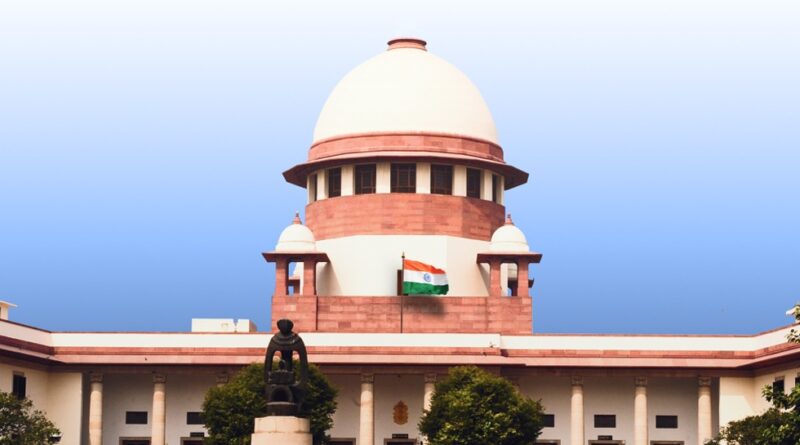
Supreme Court Strikes Down Tribunal Reforms Act 2021, Orders National Tribunals Commission Within Four Months
Landmark judgment accuses government of “impermissible legislative override,” warns repeated defiance of court orders undermines constitutional supremacy
NEW DELHI, November 19 – In a scathing rebuke to the Union government’s repeated attempts to circumvent judicial pronouncements, the Supreme Court has struck down the Tribunal Reforms Act 2021 as unconstitutional, holding that it merely repackaged provisions already invalidated in earlier judgments without curing their constitutional defects.
Chief Justice of India B.R. Gavai, delivering the judgment in a batch of petitions led by the Madras Bar Association, declared that the 2021 Act violated fundamental principles of separation of powers and judicial independence by reinstating provisions such as a minimum age requirement of 50 years for tribunal appointments, a truncated four-year tenure, and executive-dominated selection committees.
“The Impugned Act does not ‘cure’ the law declared earlier, but consciously defies it,” the Chief Justice observed, noting that the legislation was “old wine in a new bottle” that failed to address constitutional infirmities repeatedly highlighted by the court over three decades.
The court expressed strong disapproval of what it termed an “impermissible legislative override,” emphasizing that while Parliament has wide legislative powers, it cannot simply ignore binding judicial decisions. “Parliament may respond by removing the basis of the judgment through curative legislation, but it cannot simply enact a statute that reproduces or perpetuates the very defects the Court has critiqued,” the judgment stated.
A Three-Decade Battle
The ruling represents the culmination of a constitutional dialogue spanning eight major Supreme Court judgments since 2010, beginning with Union of India v. R. Gandhi, President, Madras Bar Association. Through successive decisions in 2014, 2015, 2020, 2021, and 2022, the court had repeatedly struck down various iterations of tribunal reform legislation for undermining judicial independence.
In each instance, the government responded with fresh legislation that, according to the court, essentially replicated the invalidated provisions with minor modifications. The 2021 Act, which replaced a similarly worded ordinance from April 2021, was found to be substantively identical to provisions already declared unconstitutional.
Key Constitutional Violations
The court identified several critical flaws in the 2021 Act:
- Minimum Age Requirement: The provision barring persons below 50 years from tribunal appointments was held to be arbitrary and discriminatory, excluding younger, competent advocates and professionals with relevant expertise. The court noted that advocates can be appointed as High Court judges with just 10 years of practice, making the 50-year threshold “inexplicable and therefore entirely arbitrary.”
- Truncated Tenure: The four-year term prescribed for tribunal members was found to discourage meritorious candidates and increase executive interference, compromising judicial independence. Earlier judgments had mandated a five-year term to ensure stability and expertise development.
- Panel of Two Names: The requirement that selection committees recommend two candidates per post gave the executive undue discretion in appointments, contrary to the court’s direction that only one name should be recommended to eliminate executive influence.
- Executive Control: The composition of Search-cum-Selection Committees with executive dominance was held to undermine the independence essential for quasi-judicial bodies.
Constitutional Supremacy Reaffirmed
In a strongly worded analysis, the court emphasized that India follows a model of constitutional supremacy, not parliamentary supremacy. “Under the model of constitutional supremacy, every organ of the State derives its authority from the Constitution and remains bound by the limitations it prescribes,” Chief Justice Gavai wrote.
The judgment rejected the Attorney General’s contention that the court could not test legislation against “abstract principles” like separation of powers and judicial independence. “These structural principles provide the normative boundaries within which Parliament must legislate,” the court held, noting they are embedded in the constitutional text, scheme, and spirit.
Quoting Dr. B.R. Ambedkar from the Constituent Assembly debates, the court warned that “it is perfectly possible to pervert the Constitution, without changing its form by merely changing the form of the administration and to make it inconsistent and opposed to the spirit of the Constitution.”
National Tribunals Commission Mandated
The Supreme Court gave the Union government four months to establish an independent National Tribunals Commission to oversee appointments, functioning, and administration of all tribunals. This body has been repeatedly recommended since 1997 but never implemented.
“The creation of such a commission is an essential structural safeguard designed to ensure independence, transparency, and uniformity in the appointment, administration, and functioning of tribunals across the country,” the court stated.
Until the commission is established, all tribunal appointments and service conditions will be governed by the principles laid down in the 2021 judgments in Madras Bar Association cases, which mandate:
- No minimum age bar; advocates with 10 years of practice eligible
- Five-year tenure or age 70/67 (for chairpersons/members)
- Selection committees to recommend only one name per vacancy
- Chief Justice of India or nominee as chairperson with casting vote
- Enhanced house rent allowance of ₹1.5 lakh for chairpersons and ₹1.25 lakh for members
Impact on Pending Cases and Appointments
The judgment protected the tenure and service conditions of members appointed based on recommendations made before the 2021 Act came into force, even if formal notifications were issued later. It specifically directed that Income Tax Appellate Tribunal members appointed in September-October 2021 would be governed by the old rules, not the 2021 Act.
The court also expressed concern about the massive pendency crisis caused by unfilled tribunal vacancies, noting that persistent uncertainty in the tribunal system directly affects access to justice for citizens.
Institutional Frustration
In unusually strong language, the court lamented the waste of valuable judicial time in repeatedly addressing the same constitutional issues. “It is indeed unfortunate that instead of giving effect to the well-established principles laid down by this Court on the question of the independence and functioning of tribunals, the legislature has chosen to re-enact or re-introduce provisions that reopen the same constitutional debates,” Chief Justice Gavai observed.
Justice K. Vinod Chandran, in his concurring opinion, aptly summarized the situation: “The Tribunal Reforms Act, 2021 is a replica of the struck down Ordinance; old wine in a new bottle, the wine whets not the judicial palette, but the bottle merely dazzles.”
The judgment marks a watershed moment in Indian constitutional jurisprudence, firmly establishing that no institution—including Parliament—can claim supremacy over the Constitution, and that judicial pronouncements on constitutional matters must be respected and implemented in both letter and spirit.
The ruling is expected to have far-reaching implications for the functioning of 19 major tribunals across the country, including the Income Tax Appellate Tribunal, National Company Law Tribunal, Debt Recovery Tribunals, and Central Administrative Tribunal, which together handle hundreds of thousands of cases annually.
Case Reference: Madras Bar Association v. Union of India (Writ Petition (C) No. 1018 of 2021)