Tejas Crash at Dubai Airshow: A Tragic Loss, But India’s Indigenous Fighter Maintains Superior Safety Record Over Rival JF-17
While the fatal accident underscores the inherent risks of high-performance aerobatics, the HAL Tejas has suffered only two crashes in over two decades of flight operations — compared to at least eight for Pakistan’s JF-17 Thunder, highlighting the robustness of India’s homegrown light combat aircraft.
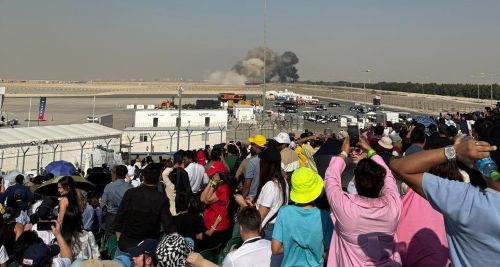
Dubai/New Delhi, November 22, 2025 — A sombre shadow fell over the final day of the Dubai Airshow 2025 yesterday when an Indian Air Force (IAF) HAL Tejas Mk-1 light combat aircraft crashed during a solo aerobatic display at Al Maktoum International Airport, claiming the life of the pilot, Wing Commander Namansh Syal. Eyewitness videos captured the single-engine delta-wing fighter losing control mid-manoeuvre, plummeting to the ground and erupting in a fireball just off the runway. Emergency teams responded swiftly, but the pilot could not eject in time.
The IAF immediately instituted a court of inquiry to determine the cause, with preliminary observations pointing to a possible loss of control during a high-G or negative-G manoeuvre — a risk amplified in airshow demonstrations where pilots push aircraft to their limits for spectacle. This marks the first fatality in the Tejas programme and only the second hull loss since the aircraft’s maiden flight in 2001: the prior incident occurred in March 2024 during a training sortie in Rajasthan, where the pilot ejected safely due to suspected engine issues.
While profoundly tragic, the accident must be viewed in context. The Tejas has flown thousands of sorties across rigorous testing, squadron service since 2016, and international demonstrations with an exemplary safety record until recently. Over 24 years, just two incidents represent one of the lowest accident rates among fourth-generation fighters in their maturation phase, especially for a fully indigenous design developed under sanctions and technological constraints.
In stark contrast stands the Tejas’s direct regional counterpart and frequent rival in export markets: the Pakistan Air Force’s (PAF) CAC/PAC JF-17 Thunder, a Sino-Pakistani co-developed lightweight multirole fighter inducted around the same period.
Reliable aviation safety databases, including the Flight Safety Foundation’s Aviation Safety Network, and verified reports document at least eight JF-17 crashes since its entry into PAF service in 2007-2010:
- November 2011: Training mission crash, pilot killed.
- September 2016: Crash during routine operations.
- Additional incidents in 2019-2020 (including one confirmed by ejection-seat manufacturer Martin-Baker but initially downplayed by PAF).
- September 2020: Hidden crash revealed via ejection data.
- August 2021: Another loss.
- Further accidents in 2024, including a confirmed Block 2 crash in June during training in Punjab’s Jhang district.
- Reports of additional losses in routine operations and potential combat-related incidents in 2025 border skirmishes (though some remain unconfirmed due to PAF opacity).
Many JF-17 incidents have been attributed to recurring issues with the Russian-sourced RD-93 engine (flameouts, thrust inconsistencies) and maintenance challenges, leading to frequent groundings of portions of the ~150-strong fleet. Pakistani sources often suppress details, with confirmations emerging indirectly through foreign ejection-seat makers or social media.
Adjusting for operational intensity and fleet size, the JF-17’s accident rate is roughly four times higher than the Tejas’s pre-2025 record. This disparity underscores the Tejas’s mature fly-by-wire systems, reliable General Electric F404/F414 engines, and stringent IAF oversight — factors that have contributed to its growing export interest from nations seeking affordable, proven platforms.
Defence analysts note that airshow crashes, while rare today, have afflicted even established fighters: F-16s, Mirage 2000s, and Su-30s have all suffered similar demo losses due to the extreme low-altitude, high-stress regimes involved. The Tejas incident is unlikely to derail major orders, including the recent ₹62,000+ crore deal for 97 Mk-1A variants or the upcoming Mk2 programme.
As India mourns a brave pilot and supports his family, the broader narrative remains one of resilience: the Tejas, a symbol of Atmanirbhar Bharat, continues to outperform its Pakistani equivalent in reliability, even amid this setback. The inquiry’s findings will further strengthen an already impressive safety legacy.