The Crown Prince Returns: Tarique Rahman Lands in Dhaka After 17 Years, Sets Stage for Epic Political Battle
Khaleda Zia’s son touches down at Sylhet airport with wife and daughter; lakhs of BNP supporters brave winter chill to welcome ‘future PM’; February election to decide Bangladesh’s fate after Hasina’s ouster
DHAKA | December 26, 2024
History came full circle in Bangladesh on Thursday morning when Tarique Rahman—the man his supporters call the “Crown Prince” of Bangladeshi politics—stepped onto his homeland’s soil after spending 17 long years in exile in London. The 60-year-old acting chairman of the Bangladesh Nationalist Party landed at Sylhet’s Osmani International Airport at 9:58 AM, accompanied by his wife Dr. Zubaida Rahman, daughter Zaima, and even their pet cat Zeebu.
What followed was nothing short of a political earthquake.
The Homecoming of a Lifetime
The Biman Bangladesh Airlines flight that brought Rahman home wasn’t just carrying passengers—it was carrying the hopes and dreams of millions of BNP supporters who have waited nearly two decades for this moment. Party workers had started gathering since Tuesday night, braving the December cold, clutching banners and wearing party caps, their eyes scanning the skies for that one aircraft.
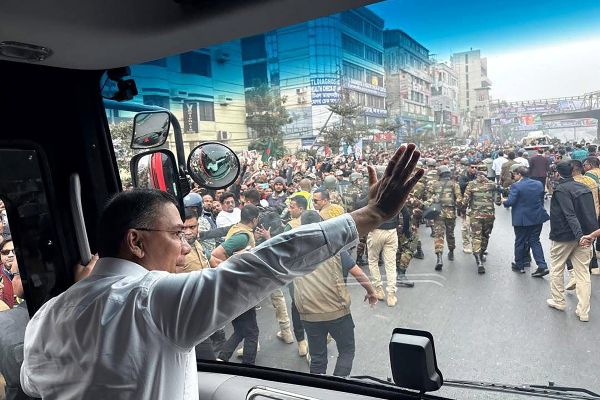
By the time Rahman’s plane touched down, the scene outside Dhaka’s Hazrat Shahjalal International Airport resembled a festival more than a political reception. According to BNP estimates, nearly one lakh party workers had assembled on the roads from Mohakhali to the airport. Some reports suggest the actual crowd could have been much larger—the party initially expected around 50 lakh supporters across various gathering points in the capital.
A massive stage had been erected on the 300-foot road (now called the 36 July Expressway, renamed after the student uprising that toppled Sheikh Hasina’s government). The setup wasn’t just grand—it was a statement. This wasn’t just about welcoming a leader back home. This was about announcing the return of a political dynasty that many thought was finished.
From Prison Cell to Exile, Now to Power?
Rahman’s journey reads like a political thriller. Born in 1965 in Guwahati—yes, in India, where his mother Khaleda Zia had taken refuge during the 1971 Liberation War—Tarique’s life has been shaped by Bangladesh’s tumultuous political history. He was barely six years old when his father, military strongman Ziaur Rahman, seized power in the aftermath of Sheikh Mujibur Rahman’s assassination in 1975. And he was just 15 when his own father was gunned down in an attempted coup in 1981.
But it’s what happened in the 2000s that really defined his political exile. During the BNP’s rule from 2001 to 2006, when his mother was Prime Minister, Rahman emerged as a powerful figure—too powerful, some said. The phrase “Hawa Bhaban” became synonymous with a parallel power center that many claimed Rahman operated from his residence. Allegations flew thick and fast: corruption, extortion, influence peddling.
Then came the crackdown. In 2007, under an army-backed caretaker government, Rahman was arrested during an anti-corruption drive. He fell seriously ill in custody, claiming torture. In 2008, he was granted bail on medical grounds and flew to London for treatment. That was September 2008. He never returned—until now.
The legal noose kept tightening even in absentia. In 2018, a Bangladeshi court handed him life imprisonment for masterminding the August 21, 2004 grenade attack on an Awami League rally—an attack that killed 24 people and was aimed at Sheikh Hasina herself. He faced 84 cases in total: corruption, money laundering, sedition, murder conspiracy.
But here’s where the story takes a dramatic turn. After Sheikh Hasina’s government collapsed in August 2024 following massive student-led protests, the political winds shifted completely. On December 2, 2024, the High Court acquitted Rahman and 48 others in the grenade attack case, citing “mistrial.” One by one, all 84 cases against him have been cleared or stayed. The path home was finally clear.
Why Now? Why Does It Matter?
The timing of Rahman’s return isn’t coincidental—it’s calculated. Bangladesh is scheduled to hold its 13th parliamentary election on February 12, 2026, marking the first free and fair polls since Hasina’s departure. The country has been under an interim government led by Nobel laureate Dr. Muhammad Yunus since August 2024.
And here’s the kicker: the Awami League, which ruled Bangladesh for 15 consecutive years, has been banned. Sheikh Hasina is in India, her political future uncertain. The field is wide open, and the BNP—dormant for so long—suddenly looks like the frontrunner.
BNP Standing Committee member Salahuddin Ahmed captured the mood perfectly when he told reporters at the airport: “The return of Tarique Rahman to his motherland is a historic event in the 55-year history of Bangladesh. Millions of people across the country are waiting just to see him once and hear a few words from him.”
Political analysts are less dramatic but equally certain about the significance. “After Bangabandhu Sheikh Mujibur Rahman and Sheikh Hasina, Tarique Rahman is among the few major leaders to return after such a long exile,” noted political historian Dr. Zahed Ur Rahman. “This is perhaps the most challenging political moment Bangladesh has faced since the mid-1970s.”
The Mother Factor
Rahman’s first stop after the grand reception won’t be party headquarters—it’ll be Evercare Hospital, where his 80-year-old mother Khaleda Zia has been receiving treatment. The former two-time Prime Minister’s health has been deteriorating, and there’s an unstated understanding within the BNP: the torch is being passed.
Khaleda Zia herself spent years under house arrest during Hasina’s rule, convicted in corruption cases that BNP supporters insist were politically motivated. She was released on humanitarian grounds but remains too frail to lead the party actively. Her son’s return isn’t just emotional for the family—it’s strategic for the party.
From the hospital, Rahman will proceed to pay respects at his father Ziaur Rahman’s mausoleum. The symbolism isn’t lost on anyone: the son of Zia is picking up where his father left off, determined to reclaim what he sees as his political inheritance.
The Challenges Ahead
But let’s be clear—Rahman isn’t returning to a hero’s welcome from everyone. The man is divisive, to put it mildly. His critics remember the “Hawa Bhaban” era, the corruption allegations, the concentration of power in his hands during his mother’s government. Many see him as representing the old politics of patronage and dynastic control.
Then there’s the security situation. Bangladesh isn’t exactly stable right now. The assassination of youth leader Sharif Osman Hadi in Singapore on December 18—who died from injuries sustained in a Dhaka attack—has sparked massive protests. Just a day before Rahman’s arrival, a crude bomb was hurled from a flyover in Dhaka’s Moghbazar area, killing a bystander. Extremist groups are gaining ground, law enforcement is weakened, and the country is walking a political tightrope.
Dr. Muhammad Yunus’s interim government is doing its best to maintain order, but cracks are showing. Khodabakhsh Chowdhury, a former Inspector General of Police and special assistant to the Home Ministry, resigned just as Rahman was arriving—the fourth major resignation from Yunus’s government. Offices of prominent newspapers like The Daily Star and Prothom Alo were set on fire by mobs. A church bombing on Christmas eve killed one person.
Political analyst Dr. Zahed Ur Rahman warned: “Tarique Rahman is not returning in a moment of relief or celebration alone, he is returning amid deep uncertainty. While a fair election could potentially propel him to the highest office, reaching that point will require navigating threats ranging from anarchic forces to institutional fragility.”
Can He Actually Become Prime Minister?
This is the million-dollar question. Or rather, the 170-million-person question (Bangladesh’s population). Rahman has never held ministerial office, preferring to work behind the scenes as an organizational leader. He rose through BNP ranks to become senior joint secretary general in 2002 and senior vice chairman in 2009, but always avoided the limelight—partly by choice, partly by necessity.
Now, he’s being thrust into the spotlight whether he likes it or not. BNP leaders are already positioning him as their prime ministerial candidate. The party’s organizational machinery is being revved up for the election campaign, with Rahman at the helm.
The math looks favorable. With the Awami League banned and Sheikh Hasina out of the picture, BNP faces weakened opposition. The interim government has assured that elections will be free and fair—a claim that Chief Adviser Dr. Yunus reiterated during a recent meeting in London where he reportedly met Rahman and gave assurances about the February timeline.
But elections in Bangladesh have never been just about math or manifestos. They’re about money, muscle, alliances, and the ability to navigate the complex web of military influence, Islamic groups, and international pressure. Rahman will need to prove he can do all of that while also distancing himself from the corruption image that has dogged him for two decades.
What He Said (Or Will Say)
Rahman was scheduled to deliver his first public address on Bangladeshi soil in 17 years at the 300-foot road reception. BNP insiders say he plans to outline his political vision, thank supporters for their patience, and set the tone for the election campaign.
The party’s Secretary General Mirza Fakhrul Islam Alamgir, who traveled to London in late November to coordinate the return logistics, is expected to host the main reception. The messaging will be carefully crafted: unity, democracy, anti-fascism, and a “new Bangladesh” free from the authoritarianism of the Hasina era.
The Regional and International Angle
Rahman’s return hasn’t gone unnoticed in the region. India, which harbored Sheikh Hasina after her ouster, is watching nervously. The BNP has historically been seen as less friendly to Indian interests compared to the Awami League. Pakistan, on the other hand, might view Rahman’s potential rise as a positive development.
The United States has been pushing for democratic reforms in Bangladesh and free elections. China has significant economic interests in the country. How Rahman navigates these international relationships will be crucial.