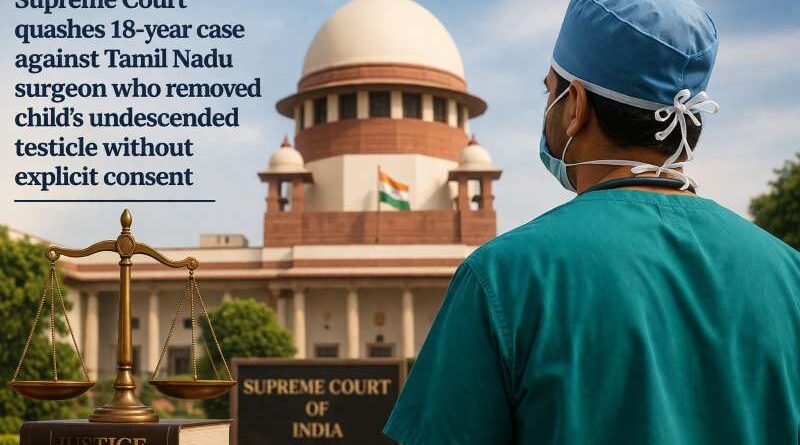
Top court frees Chennai surgeon after 18-year legal battle, calls criminal case an abuse of process
Supreme Court quashes forgery and negligence charges against paediatric surgeon who removed a toddler’s undescended testicle, finding no evidence to support either allegation
NEW DELHI, 6 April 2026 — A paediatric surgeon spent nearly two decades fighting criminal charges for removing a toddler’s testicle during surgery. On Sunday, the Supreme Court of India put an end to it, ruling that the case had no business going to trial in the first place.
Dr. S. Balagopal, a consultant paediatric surgeon at Sri Ramachandra Medical Centre in Porur, Chennai, performed the operation on a one-and-a-half-year-old boy in August 2005. The child had been admitted for treatment of an undescended testicle. During surgery, Dr. Balagopal found the organ to be small, cystic, and abnormal — what doctors describe as a “nubbin of tissue” — and removed it.
The boy’s father alleged that he had only consented to a procedure to reposition the testicle, not remove it. He further alleged that the surgeon had fraudulently inserted the word “orchidectomy” — the medical term for removal — into the consent form after the fact, to make it appear that permission had been granted. A police case was registered in 2006. A charge-sheet followed in 2008. What began as a complaint wound its way through the courts for the better part of two decades.
The Madras High Court refused to quash the proceedings twice — once in 2013 and again in September 2023. Dr. Balagopal then approached the Supreme Court.
A bench of Justice Pamidigantam Sri Narasimha and Justice Manoj Misra heard the matter and delivered its judgment on Sunday, quashing the case entirely.
The court’s reasoning was straightforward. A Medical Board, constituted by the Madras High Court itself and comprising government specialists in paediatric surgery, pathology, and oncology, had already concluded that the removal of the testicle was the appropriate surgical procedure given its condition. The Director of Medical and Rural Health Services, Tamil Nadu, who examined the consent form at the investigating officer’s request, found nothing suspicious about it — noting that both procedures were already listed on the printed form, separated by a slash. And crucially, there was no forensic report of any kind establishing that the word “orchidectomy” had been added later in a different ink or a different handwriting.
“Continuance of criminal proceedings against the appellant would be nothing but abuse of the process of the court,” the bench held.
The court noted that a surgeon operating on a patient is best placed to judge intraoperatively which procedure is warranted. Where medical experts have endorsed the clinical decision and there is no material evidence of forgery, keeping a doctor in the dock serves no legitimate purpose.
The child’s father, who appeared in person before the Supreme Court, maintained that the surgeon had telephoned him mid-surgery to ask whether to proceed with removal, and that he had said no. The court took note of his account but found it could not outweigh the weight of expert and documentary evidence pointing the other way.
The judgment draws on the Supreme Court’s 2005 ruling in Jacob Mathew v. State of Punjab, which established that criminal prosecution of a doctor requires proof of a standard of conduct so far below the ordinary that no reasonable medical professional would have acted that way — a far higher bar than civil negligence. While the present case turned on consent rather than clinical competence, the court said the principle of protecting doctors from harassment through criminal proceedings remained squarely applicable.
The case is closed. There is no order as to costs.