“Will Quit if RSS Asks, But No One Is Forced to Retire”: Bhagwat Clarifies Age Debate While Defending English Ban in Sangh Activities
RSS Chief Mohan Bhagwat Addresses Retirement at 75, Caste in Leadership, Language Politics, and Immigration at Mumbai Centenary Lecture; Says English Will Never Be Primary Language in RSS Operations Despite Global Necessity
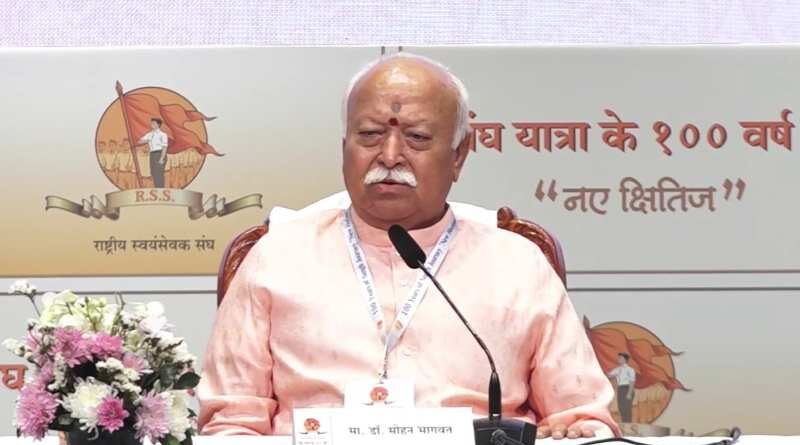
MUMBAI — In a comprehensive address that touched upon some of the most contentious issues facing Indian society, Rashtriya Swayamsevak Sangh (RSS) chief Mohan Bhagwat on Sunday clarified his controversial remarks about retirement at age 75, defended the organization’s stance on English language usage, and outlined the RSS’s vision on issues ranging from caste in leadership to illegal immigration and the Uniform Civil Code.
Speaking at the second day of the ‘Mumbai Vyakhyanmala’ (lecture series) marking the RSS’s centenary year, Bhagwat sought to address criticism and confusion stemming from his earlier statements while reaffirming the Sangh’s ideological positions on cultural and social matters.
The Retirement Question: From Stepping Aside to Working Until Called
Addressing the elephant in the room, Bhagwat directly confronted the controversy surrounding his July 2025 remarks about leaders stepping aside at age 75—comments that had been widely interpreted as a veiled message to Prime Minister Narendra Modi, who turns 75 in September 2025, the same month as Bhagwat himself.
“If the Sangh asks me to leave my position, I will do so immediately,” Bhagwat stated on Sunday, emphasizing the organization’s principle of absolute obedience to collective decisions. However, he quickly added a crucial caveat that effectively reversed the implication of his earlier remarks.
“The RSS takes work from its volunteers until the last drop,” he declared. “In the history of the Sangh, there has never been a situation where someone had to be forcibly retired.”
This statement represents a significant shift from his July 9, 2025 comments in Nagpur, where he had quoted late RSS ideologue Moropant Pingle saying that when someone is honored with a shawl at 75, “it means you should stop now, you are old, step aside and let others come in.”
The July remarks had triggered a political firestorm, with opposition parties seizing upon them as evidence of RSS displeasure with Modi’s leadership. Congress leaders had particularly relished the coincidence that both Bhagwat and Modi turn 75 in September 2025.
On Sunday, Bhagwat sought to close that door definitively. “Generally, it is said that there is a tradition of not staying in a position after the age of 75,” he acknowledged, before adding the critical qualifier: “The RSS works with its volunteers until the very end.”
He emphasized that age cannot be cited as a reason to refuse responsibility within the organization. “Even if a person is 80 years old, if the Sangh asks him to run a shakha (local unit), he must do so,” Bhagwat stated.
Caste Is No Qualification for Leadership
In a significant statement addressing questions about the RSS’s internal hierarchy and leadership selection, Bhagwat declared that caste plays no role in determining who can become Sarsanghchalak (RSS chief).
“Being a Kshatriya, Vaishya, Shudra, or Brahmin is not a qualification for becoming Sarsanghchalak,” he stated emphatically. “Whoever works for the Hindu organization becomes the RSS chief.”
This statement carries particular weight given longstanding criticism of the RSS regarding caste dynamics within Hindu society. Bhagwat’s remarks appeared designed to project the organization as inclusive and merit-based in its internal operations.
The Language Politics: English Will Never Lead, But Must Be Learned
Perhaps the most detailed and revealing section of Bhagwat’s address concerned language policy—an issue that has increasingly become a flashpoint in debates about Indian identity, cultural preservation, and economic opportunity.
Bhagwat took a nuanced but firm position: “English will never become the primary language in the functioning of the Sangh because it is not an Indian language. Where necessary, English is used. We should learn English, but we should not forget our mother tongue.”
This statement reflects a careful balancing act. While acknowledging the practical necessity of English in certain contexts—particularly in a globalized economy and international relations—Bhagwat drew a clear line about its role within the RSS’s internal operations and cultural framework.
The remarks come in the context of Bhagwat’s broader campaign for “Swadeshi” habits in Indian households. At the previous day’s session on February 7, attended by over 900 eminent personalities including Bollywood actors Salman Khan and Ranbir Kapoor, he had outlined five core areas where families should practice cultural self-reliance:
- Bhasha (Language): Use mother tongue or native Indian languages at home, reducing reliance on foreign languages for daily interpersonal communication within the family.
- Bhusha (Attire): Prioritize Indian clothing and traditional attire to support local weavers and the domestic textile industry.
- Bhraman (Tourism): Visit Indian destinations and heritage sites before traveling abroad, keeping “the country’s wealth within its borders.”
- Bhojan (Food): He famously used the “Shikanji vs Cola” example, stating: “If a beverage like lemonade can be made at home, there is no need to buy foreign carbonated soft drinks.”
- Bhavan (Home/Living): Design and maintain homes according to Indian traditions and environmental ethics.
On language specifically, Bhagwat had stated on February 6 in Kerala: “Within the four walls of our house, language, clothing, devotion, food, and bhavan should be our own. In my house, I will speak Malayalam because it is my mother tongue. I will not speak English.”
He urged Hindu families to hold weekly discussions to evaluate whether their lifestyle adheres to these principles.
The Economic Vision: Swadeshi Without Isolationism
Bhagwat’s language policy is intimately connected to his broader economic vision of “Swadeshi”—a term historically associated with India’s independence movement and now revived as a framework for self-reliance.
“The world is interdependent, but that should not become helplessness,” Bhagwat said, in remarks widely interpreted as a response to escalating global trade tensions and tariff-driven policies, particularly from the United States.
He called for a development model balanced on three pillars: self-reliance, environmental sustainability, and Dharma-based economics.
“If goods can be made in your own village or country, do not buy them from abroad,” Bhagwat urged. “Import only what is essential and cannot be produced here. Buying foreign goods that are already available locally hurts local vendors and weakens the domestic economy.”
Emphasizing national choice over economic coercion, he stated: “People should think about how their choices support employment in the country. Global engagement, wherever necessary, should be carried out in a way that suits India’s interests and environment, and should not be tariff-driven.”
His statement comes amid ongoing India-US trade negotiations and criticism from the Congress party that the BJP-led government has buckled under American pressure, particularly regarding agricultural policies.
Uniform Civil Code: Unity, Not Division
On the contentious issue of the Uniform Civil Code (UCC), Bhagwat struck a conciliatory tone, emphasizing the need for consensus-building.
“The Uniform Civil Code should be made by taking everyone into confidence, and it should not increase differences in society,” he stated, acknowledging the sensitivity of the issue that affects personal laws across religious communities.
Immigration and Population Dynamics
Bhagwat addressed what he characterized as changing “population dynamics” in India, expressing concern about illegal immigration and differential birth rates.
“The government has a lot of work to do on the issue of infiltration,” he stated. “There should be a process of identification and deportation. This was not happening earlier, but now it has started slowly and will move forward.”
He specifically referenced illegal Bangladeshi and Rohingya immigrants, stating that identifying and deporting them is the government’s responsibility, though citizens can provide information to relevant authorities.
On population dynamics more broadly, Bhagwat suggested that infiltration and varying birth rates have altered India’s demographic composition—a theme that has been central to Hindu nationalist discourse for decades.
India-US Trade Deal and Veer Savarkar
Bhagwat expressed cautious optimism about the recently concluded India-US trade agreement. “It is hoped that the India-America trade agreement has been done keeping India’s interests in mind and the country will not suffer any kind of loss,” he said.
On a different note, he reiterated the long-standing RSS demand regarding Hindutva ideologue V.D. Savarkar: “If Veer Savarkar is given the Bharat Ratna, it will further enhance the dignity of the award.”
This statement reflects the RSS’s continued effort to secure India’s highest civilian honor for Savarkar, a controversial figure revered by Hindu nationalists but criticized by others for his alleged British collaboration.
RSS Philosophy and Political Relations
Bhagwat used the Mumbai platform to clarify the RSS’s relationship with politics and power, stating emphatically: “The work of the RSS is not propaganda, but to develop values in society. Too much publicity leads to showiness and then arrogance. Publicity should be like rain—at the right time and in limited quantities.”
He stressed that the RSS is not against anyone and does not desire power or authority. “The Sangh is not directly involved in politics, although some people from the Sangh are active in politics,” he stated.
Addressing perceptions about the RSS’s relationship with the BJP and Prime Minister Modi, Bhagwat said: “Many people say that Narendra Bhai is the RSS’s Prime Minister. His political party, BJP, is separate. There are many volunteers in it, but not from the Sangh. Volunteers of the Sangh are in it.”
He acknowledged that there might be “struggle” between the RSS and BJP but insisted their goals remain aligned. “Struggle might be there, but there is no quarrel,” he clarified.
Interestingly, Bhagwat also invoked Biblical imagery to describe the RSS’s mission: “A line from the Bible could also be applied to the RSS—that it has come to fulfill, not to destroy.”
Hindu Identity: Adjective, Not Noun
In what may become one of his most quoted formulations, Bhagwat declared that “Hindu is not a noun, but an adjective”—an identity marker that is cultural and civilizational rather than narrowly religious.
He asserted that all Indians are essentially Hindu regardless of their current religion because they share the same ancestry and cultural heritage. “In India, there are only Hindus, and there is no one else. It does not represent a religion associated with any particular ritual or prayer, nor is it the name of any specific community,” he stated.
This led him to a controversial conclusion about communal terminology: “Saying Hindu-Muslim unity is not accurate,” he argued, because in his framework, Muslims in India are also part of the broader Hindu civilizational identity.
Bhagwat also criticized the common translation of secularism as “dharmanirpekshata” (neutrality toward dharma), arguing that the correct term should be “panthnirpekshata” (neutrality toward different sects or ways of worship), as Dharma itself—which he defined not as religion but as a “universal code of conduct”—cannot and should not be approached with neutrality.
Vision of Vishwaguru
Looking toward India’s global role, Bhagwat articulated an ambitious vision tempered with moral responsibility.
“Bharat will become a superpower, but it must rise as Vishwaguru (world teacher) as well,” he stated. “Becoming Vishwaguru requires hard work, including character-building and societal organization, not domination. As long as Dharma drives Bharat as the sustaining force for all existence, it will retain this role and uplift the world.”
He emphasized that India would become Vishwaguru “not by domination but by leading from within and by example.”
Wikipedia and the Information War
In a revealing aside about the RSS’s media strategy, Bhagwat warned against relying on digital sources for understanding the organization.
“When forming an opinion about the RSS, base it on what you see and the original sources. Avoid relying on Wikipedia or perceptions, as they contain misleading information. You won’t understand the RSS through propaganda,” he stated.
This comment reflects the RSS’s long-standing concern about its portrayal in mainstream and digital media, which the organization views as biased or incomplete.
Analysis: Contradictions and Continuities
Bhagwat’s Mumbai addresses reveal an organization navigating multiple tensions:
On Retirement: The shift from “step aside at 75” to “work until the last drop” suggests either a genuine clarification of intent or a retreat under political pressure. Either way, it removes any imminent expectation of leadership change in either the RSS or its political offspring, the BJP.
On Language: The position on English—acknowledge its necessity but resist its primacy—reflects the broader dilemma facing cultural nationalism in a globalized economy. While the RSS wants to promote Indian languages, it cannot ignore English’s role as a gateway to economic opportunity and international engagement.
On Economics: The “Swadeshi” vision attempts to chart a middle path between autarky and complete globalization, but critics argue it risks economic inefficiency and protectionism in the name of cultural authenticity.
On Identity: The formulation of “Hindu” as an all-encompassing adjective rather than a specific religious noun is rhetorically clever but politically fraught, as it effectively erases religious minorities’ distinct identities by subsuming them into a broader civilizational framework they may not accept.
On Power: Bhagwat’s insistence that the RSS doesn’t seek power or control the BJP becomes harder to sustain as the ideological convergence between the two becomes more apparent in policy outcomes.
Political Implications
The Mumbai speeches have several immediate political implications:
- Succession Clarity: Both Modi and Bhagwat will continue past their 75th birthdays, ending speculation about imminent leadership transitions.
- Cultural Agenda: The emphasis on Swadeshi habits and language pride signals an intensification of cultural nationalism as a core RSS priority.
- Economic Nationalism: The RSS is positioning itself as a counterweight to uncritical globalization, particularly in the context of US-India trade relations.
- UCC Messaging: The call for consensus on the Uniform Civil Code may indicate awareness of the political risks of pushing it through over minority objections.
- Immigration Focus: Continued emphasis on illegal immigration and population dynamics suggests this will remain a key mobilization issue for the RSS and its affiliated organizations.
The Star Power Factor
The presence of Bollywood A-listers like Salman Khan and Ranbir Kapoor at the RSS centenary event is itself significant. Their attendance lends mainstream cultural legitimacy to an organization that has historically faced criticism and suspicion from liberal and secular quarters.
The celebrity endorsement—whether explicit or simply through presence—helps normalize the RSS in popular culture and potentially broadens its appeal beyond its traditional base.
Looking Ahead
As the RSS enters its second century and both Bhagwat and Modi approach their 75th birthdays, the organization faces fundamental questions about adaptation and continuity.
Can it promote cultural rootedness without seeming regressive? Can it advocate self-reliance without economic isolationism? Can it define national identity in civilizational terms without alienating religious minorities? Can it claim distance from political power while its ideological offspring runs the government?
Bhagwat’s Mumbai addresses provide the RSS’s current answers to these questions. Whether Indian society—in all its diversity—will accept those answers remains to be seen.
For now, at least two things are clear: neither Bhagwat nor Modi is stepping aside anytime soon, and the RSS’s vision of India—economically self-reliant, culturally rooted, and spiritually guided—will continue to shape national discourse whether one agrees with it or not.