50 IAS and IPS Officers Bought Land on the Same Day in Bhopal Village; Road Project Approved 16 Months Later, Land Value Soared 11-Fold
In an explosive investigation, Dainik Bhaskar reveals how ‘like-minded officers’ from multiple states quietly pooled money to buy agricultural land in Guradi Ghat village — and watched its value skyrocket from ₹81/sq ft to nearly ₹3,000/sq ft after a bypass project and land-use change followed in quick succession
By Hemender Sharma | As reported by Dainik Bhaskar
In what could turn out to be one of the most significant land-deal controversies involving senior bureaucrats in recent memory, an investigation by Dainik Bhaskar has uncovered a striking pattern of land purchases by nearly 50 IAS and IPS officers in a single village in Madhya Pradesh’s Kolar area — followed, within months, by a major road project approval and a land-use change that multiplied the value of their investment by as much as 11 times.
One Day, One Document, 50 Officers
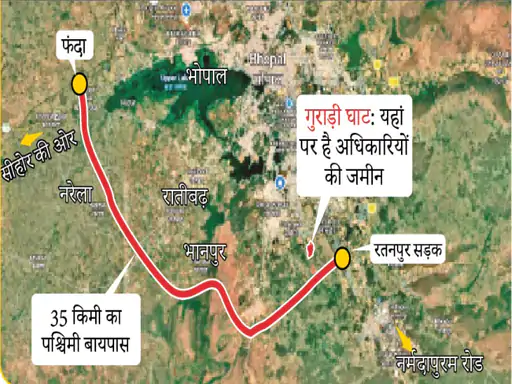
On April 4, 2022, a single registration document recorded the joint purchase of 2.023 hectares of agricultural land in Guradi Ghat village, Kolar region, on the outskirts of Bhopal. The registered price was ₹5.5 crore, with the market value recorded at ₹7.78 crore.
While 50 individuals are listed as joint buyers in the document, Dainik Bhaskar’s investigation found that the actual number of unique buyers behind these 50 shares is 41. Crucially, the land purchase was described in their Immovable Property Returns (IPR) — the mandatory annual asset disclosures filed by government servants — as property acquired by “like-minded officers.”
The buyers are not confined to the Madhya Pradesh cadre alone. The investigation reveals that officers from the Maharashtra, Telangana and Haryana cadres, as well as IAS and IPS officers posted in Delhi, are among those who participated in the purchase.
The Timeline That Raises Questions
What makes the land deal particularly eyebrow-raising is the sequence of events that followed the purchase:
April 4, 2022 — Land Purchased Around 50 officers jointly buy approximately 5 acres of agricultural land at roughly ₹81.75 per square foot.
August 31, 2023 — Western Bypass Approved Just 16 months after the purchase, the Madhya Pradesh Cabinet approved the ₹3,200 crore Western Bypass project. According to the current alignment, the bypass passes within 500 metres of the purchased land.
June 2024 — Land Use Changed to Residential A mere 10 months after the bypass approval, the land-use classification of the plot was changed from agricultural to residential — a conversion that dramatically unlocked its commercial potential.
The Numbers Tell the Story
The financial trajectory of the land is stark. At the time of purchase in 2022, the rate stood at approximately ₹81.75 per square foot. Following the land-use diversion in June 2024, the rate jumped to approximately ₹557 per square foot, taking the total value of the roughly 5-acre plot to around ₹12.13 crore.
At current prevailing market rates of ₹2,500 to ₹3,000 per square foot, the same land is now estimated to be worth between ₹55 crore and ₹65 crore — a staggering appreciation from the original investment, with the land’s value having risen nearly 11 times in just over two years.
Key Questions Remain Unanswered
Dainik Bhaskar’s investigation also notes that no housing society has been registered on the land so far, which is a mandatory step before any residential project can be developed or plots allocated to buyers. The next move — whether a society is registered or plots are directly allotted — will be closely watched.
The sequence of events — a coordinated bulk purchase by senior government servants, followed swiftly by a massive infrastructure project approval and a favourable land-use change — has raised serious questions about whether the officers had advance knowledge of the bypass alignment and the planned rezoning, and whether their IPR disclosures adequately reflect the nature and intent of the investment.
Neither the Madhya Pradesh government nor any of the officers named in the investigation have issued a public response to the findings so far.
This report is based on an investigation by Hemender Sharma, published in Dainik Bhaskar. All data and figures cited are sourced from the original Dainik Bhaskar investigation.