MIDDLE EAST IN FLAMES: IRAN-US-ISRAEL WAR ESCALATES ON MULTIPLE FRONTS
Cargo ships targeted in Strait of Hormuz, oil prices surge, two Indians killed as conflict spirals into global crisis
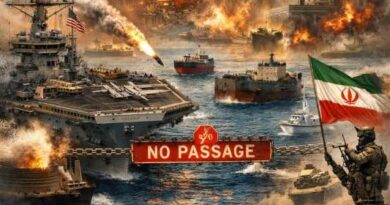
A Thai-flagged cargo vessel came under projectile attack in the Strait of Hormuz on Wednesday, as the widening war between Iran, the United States and Israel sent shockwaves across global shipping lanes, energy markets and civilian populations.
The bulk carrier Mayuri Nari, travelling from the United Arab Emirates toward India, was struck near the stern approximately 11 nautical miles north of Oman, triggering a fire in the engine room. Of the 23 crew members on board, 20 were rescued by the Omani Navy and transported to the port city of Khasab. Three crew members who were on duty in the engine room at the time of the strike remain missing. Thailand’s Transport Ministry confirmed the rescue operation, adding that the Royal Thai Navy is coordinating with international agencies.
The attack is one of the most visible signs yet of how the conflict — now in its twelfth day — is spilling into international waters.
Oil at Risk, Prices Soar
Iran’s military has made no secret of its intentions in the strait. A spokesperson for the Khatam al-Anbiya military command headquarters, Ibrahim Jolfaghari, warned Wednesday that crude oil prices could surge to $200 per barrel. He stated that Iran would no longer limit itself to retaliatory strikes but would conduct sustained offensive operations, and that any vessel delivering oil to the United States, Israel or their allies would be considered a legitimate target.
An Iranian academic went further. Professor Fouad Izadi of the University of Tehran warned that the Strait of Hormuz — through which approximately 20 per cent of the world’s oil transits — could remain closed for several months until Iran receives economic compensation for the damage it has suffered in the war.
The warnings are already translating into price rises at the pump. In the United States, petrol prices reached $3.58 per gallon on Wednesday — a 21-month high — having risen 38 cents over the past week and 64 cents over the past month. Diesel climbed to $4.89 per gallon, up 79 cents in a single week.
Indians Among the Dead
India’s Ministry of External Affairs confirmed on Wednesday that two Indian nationals have been killed in attacks on merchant vessels in the Middle East, with a third person missing. Spokesperson Randhir Jaiswal said the government remains committed to the welfare and safety of Indian citizens in the Gulf region and is closely monitoring the situation.
Iran’s 39th Missile Salvo
Iran’s Islamic Revolutionary Guard Corps (IRGC) claimed it had fired its 39th wave of missiles at American and Israeli targets. The IRGC also claimed strikes on multiple US military installations across Kuwait — including the Al-Udairi helicopter airbase, the Mohammed Al-Ahmad naval base, and Ali Al-Salem airbase — as well as a naval base in Bahrain housing American forces.
Israel, meanwhile, launched overnight strikes on Hezbollah positions in the Lebanese capital Beirut, and Israeli drone attacks in Lebanon killed at least two people near the towns of Haboush and Arabsalim. Wednesday’s strikes brought the total death toll from Israeli attacks in Lebanon to 21 for the day.
Civilian Toll Mounts
The human cost of the conflict inside Iran is staggering. Iran’s Red Crescent Society reported that nearly 19,734 civilian buildings have been damaged, including 77 medical centres and 65 educational institutions. Sixteen Red Crescent relief centres were also struck.
Iran’s Education Minister Alireza Kazemi told state news agency IRNA that 206 students and teachers have been killed in American and Israeli strikes, with 161 others wounded. Among the deadliest single incidents was a missile strike on a girls’ school in the city of Minab on 28 February, which killed at least 170 people, most of them girls aged between seven and twelve.
Italian Prime Minister Giorgia Meloni condemned the Minab school attack in the Italian Senate, calling it a massacre of girls and demanding accountability for those responsible.
Iran Withdraws from FIFA World Cup
In a striking signal of the conflict’s reach beyond the battlefield, Iran’s Sports Minister Ahmad Dunyamali announced that the national football team would not participate in the 2026 FIFA World Cup, co-hosted by the United States, Canada and Mexico. Iran’s group-stage matches were scheduled to be held on American soil. Dunyamali said participation was impossible following the killing of Iran’s Supreme Leader in the American-Israeli strikes. FIFA rules allow for penalties and future competition bans for teams that withdraw, though it remains unclear whether Iran’s decision is final.
Spain Severs Diplomatic Ties with Israel
On the diplomatic front, Spain formally withdrew its ambassador to Israel on Wednesday, a day after the government approved the measure. Madrid had recalled its envoy in September last year following escalating tensions, which worsened after Israel’s foreign minister publicly criticised Prime Minister Pedro Sánchez’s decision to condemn the violence in Gaza as genocide.
Reporting compiled from Thai Transport Ministry, Iranian state media (IRNA), Iran’s Red Crescent Society, India’s Ministry of External Affairs, and regional news agencies. The situation remains fluid.