Raghav Chadha’s BJP merger bid: a political gambit built on contested legal ground
Seven AAP Rajya Sabha MPs claim a valid merger with the BJP — but constitutional scholars argue the move bypasses the very safeguards the anti-defection law was designed to protect.
Constitutional Law Desk | April 25, 2026
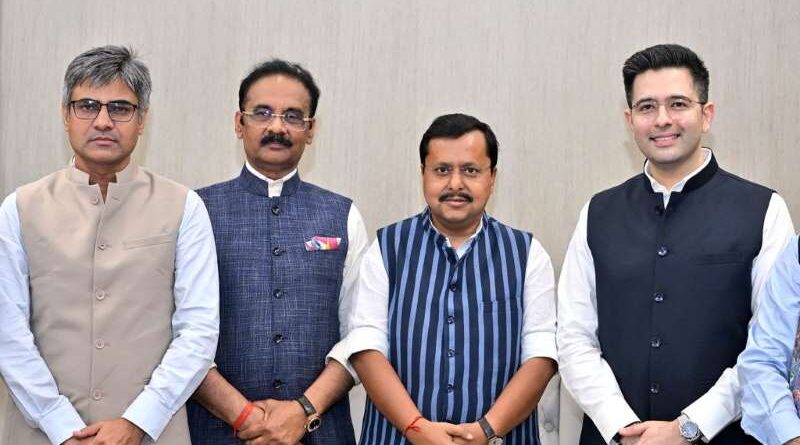
When Aam Aadmi Party’s Rajya Sabha MP Raghav Chadha announced that he and six colleagues were merging with the Bharatiya Janata Party, he did not merely trigger a political earthquake — he walked straight into one of Indian constitutional law’s most unresolved fault lines.
The move, which Chadha framed as a lawful merger shielded by Paragraph 4 of the Tenth Schedule of the Constitution, rests on a legal argument that is simultaneously supported by a High Court ruling and directly challenged by the Supreme Court’s own constitutional reasoning.
What the Tenth Schedule actually says
India’s anti-defection law draws a sharp line: any legislator who voluntarily abandons party membership invites disqualification. The Supreme Court has described defection as a “constitutional sin.” However, Paragraph 4 of the Tenth Schedule provides a narrow escape — a merger is not treated as defection if the legislator’s original political party itself merges with another, and at least two-thirds of the legislature party’s members endorse the move.
The critical phrase is “original political party.” Legal experts argue this refers to the national party organisation — in this case, AAP as a whole — not a handful of MPs sitting in a single chamber of Parliament. Without any merger declaration from AAP’s national leadership, critics contend that Chadha and his colleagues are not executing a merger at all; they are executing a defection and simply clothing it in the language of one.
The Supreme Court’s warning in Subhash Desai
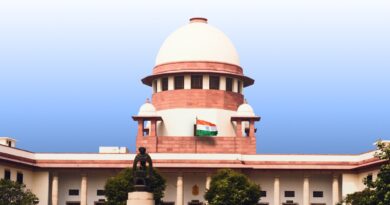
The constitutional basis for this view was laid out clearly in the Supreme Court’s 2023 Constitution Bench ruling in the Shiv Sena split case. Though that case concerned the appointment of a legislative whip rather than a formal merger, the Court was unambiguous: a legislative party cannot sever its ties from the original political party. To permit that, the Court reasoned, would allow legislators to ride a party’s name and promises into power, then walk away once elected. The Tenth Schedule, the Court said, exists precisely to prevent that outcome.
The ruling also confirmed that “political party” and “legislature party” are not interchangeable terms — a distinction that strikes at the heart of Chadha’s position. If a merger must originate with the political party, then the legislature party acting alone is, in the Court’s own framing, the tail wagging the dog.
The High Court precedent that complicates everything
Yet there is case law that could hand Chadha a lifeline. In 2022, the Bombay High Court’s Goa Bench upheld the merger of ten Congress MLAs into the BJP, ruling that a two-thirds majority of the legislature party is independently sufficient to constitute a valid merger — even without the parent party’s approval. The Court read the two sub-paragraphs of Paragraph 4 as operating separately, concluding that requiring national party approval would allow a small group of dissenting legislators to block a merger agreed upon by two major parties.
The same court reaffirmed this reading in January 2025 when a fresh batch of Congress MLAs in Goa repeated the exercise. Both decisions are now challenged before the Supreme Court, with the special leave petition still pending. Chadha’s move follows the same template — and its fate may hinge on whichever way the apex court eventually rules in the Goa case.
Why this matters beyond the headlines
The political fallout reaches well beyond the seven MPs involved. AAP, which governs Punjab and is heading into state elections, now faces a leadership and credibility crisis in Parliament. The BJP, meanwhile, gains a ready-made narrative about AAP’s internal fragility — regardless of whether the merger survives legal scrutiny.
More broadly, the episode exposes a structural gap in the anti-defection framework. As long as the Goa High Court’s interpretation remains uncorrected by the Supreme Court, a sufficiently large faction within any legislature party can engineer a political realignment and dress it up as a merger, bypassing the parent organisation entirely. The Tenth Schedule was designed to stop politicians from switching sides for personal gain after winning on a party ticket. If the legislative wing alone can declare a merger, that protection is significantly weakened.
What happens next
The immediate procedural step will likely be a disqualification petition before the Rajya Sabha Chairperson. The outcome will depend on whether the Chair — and ultimately the courts — follow the constitutional reasoning of the Supreme Court in Subhash Desai or the more text-literal approach taken by the Bombay High Court.
With the Goa petition unresolved in the Supreme Court and a fresh dispute now emerging in the Rajya Sabha, India’s highest court may finally be forced to deliver the authoritative ruling on legislative mergers that has long been overdue. Until then, the AAP’s Rajya Sabha bench remains in a state of deliberate constitutional ambiguity — and Raghav Chadha’s political future is being written in the margins of the Tenth Schedule.