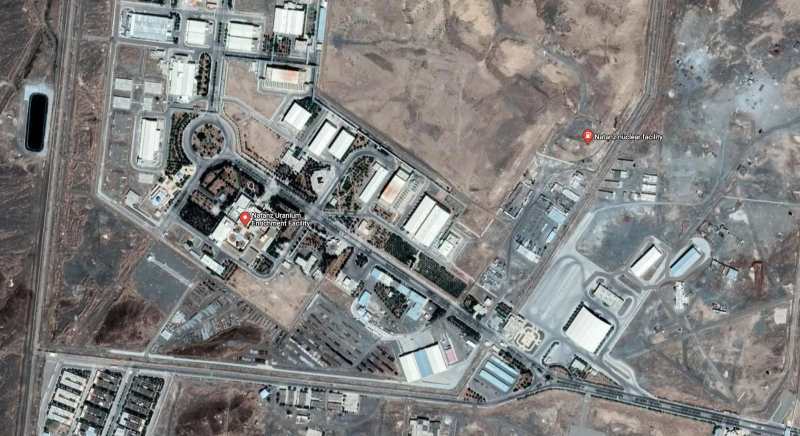
Strikes on Natanz, missile sites in Tehran: US-Israel war on Iran enters day 22 with no end in sight
As airstrikes hit Iran’s biggest nuclear facility and missile manufacturing centres in Tehran, Russia condemns the attacks as a violation of international law; crude oil prices surge to $119 per barrel amid fears of a wider conflict
New Delhi, March 21
The war between the United States, Israel and Iran entered its 22nd day on Saturday with a significant escalation — airstrikes on Iran’s Natanz nuclear facility and multiple missile manufacturing sites in Tehran, even as the conflict cast a long shadow over Eid celebrations across the Middle East and pushed crude oil prices to levels not seen in years.
Iran’s Tasnim News Agency reported that US and Israeli forces carried out an airstrike early Saturday morning on the Natanz nuclear centre — officially known as the Ahmadinejad Roshan complex — Iran’s largest uranium enrichment facility, a significant portion of which is built underground specifically to withstand aerial bombardment. Iranian authorities said there was no radioactive leakage from the strike and that residents in the surrounding areas were not at risk. The information was also conveyed to the International Atomic Energy Agency (IAEA).
The Israeli Defence Forces (IDF), however, denied involvement. “We did not carry out this attack and we do not know who did. We do not comment on American operations,” the IDF said in a statement — a carefully worded denial that stopped short of ruling out a US strike. This was not the first time Natanz has been targeted; US and Israeli forces struck the same facility on March 2.
Tehran’s missile infrastructure targeted
Separately, the IDF confirmed overnight strikes on multiple locations in the Iranian capital, saying it had targeted a major Islamic Revolutionary Guard Corps (IRGC) centre where ballistic missile components were manufactured, along with parts storage facilities, a defence ministry campus and a second missile production factory. Israel claimed the strikes had significantly degraded Iran’s missile-making capacity, though no casualty figures were provided.
Earlier, US military official Brad Cooper confirmed that American forces had dropped heavy bombs on a secret underground Iranian facility storing missiles and weapons that posed a threat to shipping in the Strait of Hormuz, adding that radar and surveillance systems at the site had also been destroyed.
Russia condemns, Iran vows retaliation
Russia was swift in its condemnation. Foreign Ministry spokesperson Maria Zakharova called the Natanz strike an open violation of international law. Iran, meanwhile, showed no signs of backing down. An Iranian official, quoted by the ISNA news agency, said the country would teach Donald Trump a lesson, accusing the US president of duplicity after he had suggested he was considering de-escalation before publicly ruling out a ceasefire.
Iran also accused US and Israeli forces of attacking private and passenger vessels in the Persian Gulf, with the IRGC claiming the strikes were deliberate.
Oil prices soar, airlines sound alarm
The economic fallout of the conflict is becoming increasingly acute. Brent crude oil, which was trading at around $70 per barrel before hostilities began, has now climbed to approximately $119.50 per barrel. United Airlines CEO Scott Kirby warned employees that jet fuel costs had more than doubled in just three weeks, and that crude could reach $175 per barrel if the situation continued — potentially adding $11 billion annually to the airline’s operating costs.
Eid under the shadow of war
The human dimension of the conflict was perhaps most starkly visible on Saturday, as Muslims across the world marked Eid. For the first time since the 1967 Arab-Israel war — a gap of nearly 60 years — the Al-Aqsa Mosque in Jerusalem was closed for Eid prayers. Islam’s third holiest site after Mecca and Medina, Al-Aqsa has remained open through decades of conflict, making its closure a deeply symbolic moment.
In Iran, Eid was observed on Friday, with bazaars and markets largely deserted. In Gulf states including Qatar, UAE and Kuwait, open-air congregational prayers were prohibited as a security precaution. Qatar’s Ras Laffan gas plant, struck by an Iranian ballistic missile on Thursday, remained a focus of concern.
The conflict shows no sign of abating, with both sides escalating strikes even as diplomatic channels appear entirely frozen.