US Military Aircraft Vanishes Over Qatar Airspace After Emergency Signal as Hormuz Standoff Spirals
A KC-135 Stratotanker disappears from radar after broadcasting a distress code over the Persian Gulf — as Iran attacks a UAE petroleum plant, a South Korean vessel is set ablaze, and Washington deploys aircraft carrier USS George H.W. Bush under ‘Project Freedom’ to force open the world’s most critical oil chokepoint.
Tel Aviv / Tehran / Washington DC, May 5, 2026 — A United States Air Force KC-135 Stratotanker aircraft disappeared from radar over Qatar’s airspace on Tuesday after broadcasting an emergency distress signal, in what is the latest — and most alarming — development in a rapidly escalating military confrontation between Washington and Tehran over control of the Strait of Hormuz.
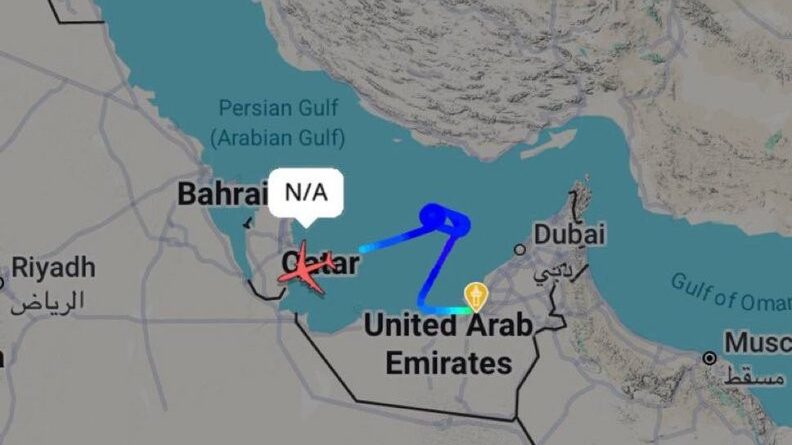
Iran’s Fars News Agency, which first reported the incident, said the aircraft transmitted a ‘7700’ emergency squawk code — the universal aviation signal for a general emergency or serious malfunction on board — before vanishing from tracking systems. Washington has so far not issued any official statement on the incident and has not confirmed the disappearance.
The aircraft had taken off from Al Dhafra Air Base in the United Arab Emirates and was flying over the Persian Gulf when its signal temporarily disappeared near Qatar. Flight data indicated the plane had been circling for a period before beginning to descend. Whether the cause was a technical failure, hostile action, or something else entirely remains unclear. Iran’s state news agency explicitly stated that it was not attributing any role in the incident to Tehran.
The KC-135 Stratotanker — known in military circles as the “flying gas station” — is one of the US military’s most critical aerial assets. Capable of mid-air refuelling of other military aircraft, it plays a central logistical role in sustaining combat air operations across extended theatres. Its disappearance, however explained, has sent a sharp jolt through an already tense regional situation.
FOUR MAJOR DEVELOPMENTS IN THE LAST 24 HOURS
1. Iran strikes UAE petroleum plant: Iran launched a drone strike on a petroleum plant in Fujairah, UAE, triggering a large fire in the industrial zone. Three Indian nationals were among the injured. The attack marked a significant escalation, bringing the conflict directly onto UAE soil for the first time in the current crisis.
2. Project Freedom launched: The United States formally launched ‘Project Freedom’ — a naval initiative centred on the Hormuz Strait. Under the programme, the US has pledged to help foreign vessels trapped in or around Hormuz navigate safely to open waters. As part of the initiative, the USS George H.W. Bush aircraft carrier — carrying over 60 aircraft — has been deployed to the strait. US Defense Secretary Pete Hegseth stated: “America does not want a war with Iran, but the safety of vessels in Hormuz is non-negotiable. Our goal is to end Iran’s illegal pressure on this maritime route. We will not need to enter Iranian airspace or maritime borders to accomplish this mission.”
3. South Korean vessel attacked: A South Korean commercial ship was attacked in the Hormuz Strait, causing a fire on board. President Trump publicly attributed the attack to Iran. No casualties have been reported.
4. Seized Iranian vessel handed over: The US military handed over the seized Iranian vessel Tuska to Pakistan, from where it was dispatched to Iran along with its 22 crew members. The US Navy had seized the ship on April 21.
5. Three executions in Iran: Three individuals accused of links to Israel’s Mossad intelligence agency were hanged in Iran. They had been charged with involvement in a plot to destabilise the government in January 2026. A total of 25 political prisoners have been executed in Iran so far this year.
DIPLOMACY IN MOTION — BUT RUNNING OUT OF ROAD
French President Emmanuel Macron is scheduled to speak with Iranian President Masoud Pezeshkian on Tuesday, with Hormuz at the top of the agenda. Macron has stated publicly that he will press Tehran to reopen the strait to commercial shipping. France and Britain are jointly working to assemble an international naval coalition to secure the passage for global maritime traffic.
However, Tehran has pushed back hard against the American alternative route proposed under Project Freedom. Iran’s Fars News Agency reported that the new corridor — routed through Omani waters — is rocky and too shallow for large commercial vessels. Two merchant ships that attempted to use the new route have reportedly become stranded, unable to move forward or turn back, as the seabed near the Omani coast is too treacherous to navigate safely.
US General Ken, speaking on Tuesday, said the decision on whether to resume full military operations against Iran would rest with the government, not the military. “This decision is above my level — it is entirely a political matter,” he said. But he added an unmistakable warning: “If the order is given, the US military is ready to launch a large-scale operation against Iran. Iran’s small-scale attacks should not be mistaken for a situation that America cannot or will not respond to. Our silence must not be read as weakness.”
HUMANITARIAN AND DIPLOMATIC FLASHPOINTS
Spain has formally demanded that Israel immediately release Spanish citizen Saif Abu Keshek, who was intercepted at sea near Greece last week alongside Brazilian national Thiago Avila. Both were part of the Global Sumud Flotilla heading for Gaza. An Israeli court extended their detention. Israel’s human rights organisation Adalah reported that both men are on hunger strike and alleged they have been mistreated in custody.
The United States Embassy has also issued a travel advisory urging all American citizens to avoid air travel to Iraq, citing credible threats from Iran-linked militant groups planning attacks on American citizens and installations. “There remains a clear and present threat of missile, drone, and rocket strikes in Iraq,” the advisory stated.
WHY THIS MATTERS
The Strait of Hormuz is the world’s single most critical oil chokepoint — approximately 20 per cent of global petroleum supplies and around a third of all liquefied natural gas trade passes through it every day. Any sustained disruption to Hormuz shipping triggers immediate consequences for global energy prices, supply chains, and the economies of every oil-importing nation — including India, which sources a substantial share of its crude oil from Gulf producers.
The disappearance of a US military refuelling aircraft over Qatar — whatever its ultimate explanation — lands in this context like a lit match near an open fuel tank. It is a reminder that in a theatre this volatile, accidents, miscalculations, and provocations carry the potential to cascade into something far larger than any single incident.
The world is watching Hormuz. And Hormuz is watching back.