Haryana Bets Big on Fruit Clusters, Natural Farming and Tech-Driven Agriculture to Boost Farmer Income
CM Nayab Singh Saini chairs review meeting, directs departments to push crop diversification, reclaim 1.4 lakh acres of waterlogged land, and crack down on harmful pesticides
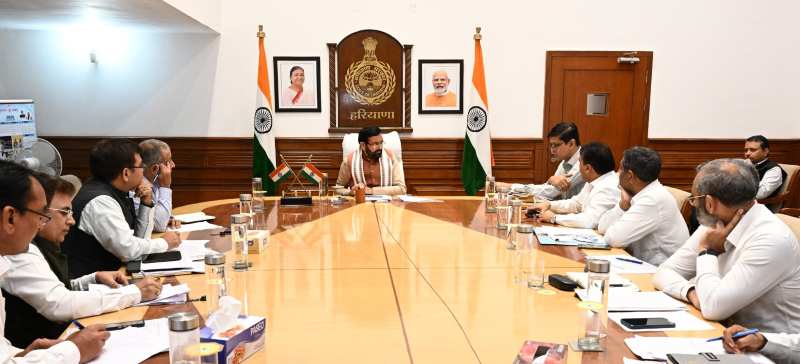
Haryana Chief Minister Nayab Singh Saini on Tuesday chaired a comprehensive review meeting of the Agriculture and Horticulture Departments, laying out an ambitious roadmap to enhance farmers’ income through crop diversification, cluster-based fruit farming, natural farming, and stronger quality controls.
Fruit Clusters and High-Value Crops
The Chief Minister directed officials to identify suitable areas and develop dedicated clusters for high-value fruit crops including strawberry, lemon, guava and dragon fruit, citing growing market demand and better price realisation for farmers. He also called for promotion of tissue culture-based production across arhar, soybean, groundnut, pulses, fruit crops and sugarcane, and stressed linking farmers directly with production, processing and marketing chains.
New Varieties and Research
Saini directed the development of new hybrid and high-yielding varieties of cotton, mustard, arhar and pulses, with a specific focus on seeds resilient to hailstorms and climate change. He asked that land available with agricultural universities and panchayats be identified for research trials, and called for greater involvement of students and research institutions to accelerate innovation.
Reclaiming Waterlogged Land
For FY 2026–27, the state has set a target of reclaiming 1,40,000 acres of waterlogged and saline land. The Chief Minister directed large-scale planting of eucalyptus trees along field bunds, canal banks and drains under a bio-drainage programme, leveraging the tree’s high water absorption capacity to naturally rehabilitate affected areas.
Natural Farming as a Mission
Saini directed officials to identify clusters across the state for promoting natural farming, with farmers to be supplied jeevamrit, organic solutions, drums and practical training. He said the natural farming model being implemented by Acharya Devvrat at Gurukul Kurukshetra should serve as the base for wider rollout. Notably, he directed that if productivity dips during the transition to natural farming, the government will compensate farmers for their losses.
Pesticide Crackdown and Organic Lab
The Chief Minister ordered regular laboratory testing of crops, fruits and vegetables for pesticide residues, directing that chemicals linked to serious diseases such as cancer be immediately prohibited. He also announced the establishment of a state-of-the-art organic laboratory for scientific testing of soil, water, organic manure and crops to monitor quality and standards in organic farming.
Farmer IDs, Fertilizer Reform and GST Milestone
In a separate development, Agriculture Minister Shyam Singh Rana informed that Farmer IDs have been created for 7,33,083 farmers — around 45 percent of the total target — under the PM-Kisan scheme, which covers 20,82,596 beneficiaries in the state. Through the Meri Fasal Mera Byora portal, fertilizer supply has now been linked to actual crops cultivated by farmers, replacing the earlier Aadhaar-based distribution system. The reform has helped Haryana save over ₹500 crore in central fertilizer subsidy this year. Union Agriculture Minister Shivraj Singh Chouhan praised the initiative, calling it a model worth replicating nationally.
On the economic front, Haryana recorded the highest State GST growth among all states in FY 2025–26, with post-settlement SGST collections rising 21.5 percent to ₹48,289 crore — far above the national average growth of 5.7 percent. The state ranked 5th among all states and Union Territories in gross domestic GST collection.