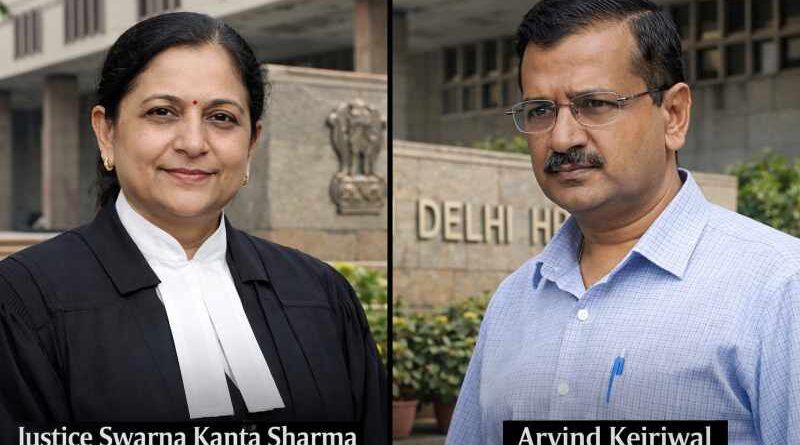
Delhi High Court Rejects Kejriwal’s Bid to Remove Judge from Liquor Policy Case
Justice Swarana Kanta Sharma rules that judges’ families cannot be barred from legal careers, dismissing conflict of interest claims as “portrayed” rather than real
Delhi High Court’s Justice Swarana Kanta Sharma has thrown out a recusal application filed by Aam Aadmi Party chief Arvind Kejriwal, who had sought her removal from the liquor policy case on the grounds that her children serve as Central government panel counsel.
Delivering her ruling in open court, Justice Sharma drew a firm line between genuine conflicts of interest and manufactured ones, stating that no evidence had been placed before her demonstrating any link between her children’s professional empanelment and the case at hand. The CBI, which is prosecuting the liquor policy matter, confirmed that none of the judge’s relatives had appeared or been involved in the excise policy proceedings before any court.
At the heart of Kejriwal’s argument was the claim that the Solicitor General had been routing cases toward Justice Sharma’s children, thereby creating what he described as an “active and ongoing professional relationship” between her family and the prosecuting side. The court rejected this framing, noting that the Solicitor General routinely allocates work across a broad pool of government panel lawyers, and that her bench was being “selectively targeted.”
Justice Sharma was pointed in her response to the suggestion that family ties alone could constitute bias. “If children of politicians can enter politics,” she observed, “it would be unfair to question judges’ family members who enter the legal profession and prove themselves on merit.” She added that accepting such reasoning would effectively prevent the court from hearing any matter involving the Union of India as a party.
The judge also addressed the broader principle that justice must not only be done but be seen to be done — a submission advanced by Kejriwal’s side. She questioned who holds the authority to define that appearance, remarking that a litigant’s anxiety about an unfavourable outcome cannot serve as legitimate grounds to allege judicial bias. Only a higher court, she noted, is empowered to assess whether a judgment has been one-sided.
Reflecting on her three-decade legal career, Justice Sharma pushed back against what she characterised as a new and troubling standard being applied to judges — one that would require them to pass unofficial tests designed by litigants themselves, scrutinising everything from their social circles to their families’ career choices.
“Personal attacks on a judge are attacks on the institution itself,” she stated, adding that falsehoods, however frequently repeated — whether in court or on social media — do not transform into truth.