The Great Nicobar Flashpoint: What Is It, Why Is Rahul Gandhi Alarmed, and What Does the Government Say?
As Rahul Gandhi calls it ecological theft and the government calls it strategic necessity, the truth about Great Nicobar lies somewhere in the deep forest
What Exactly Is the Great Nicobar Project?
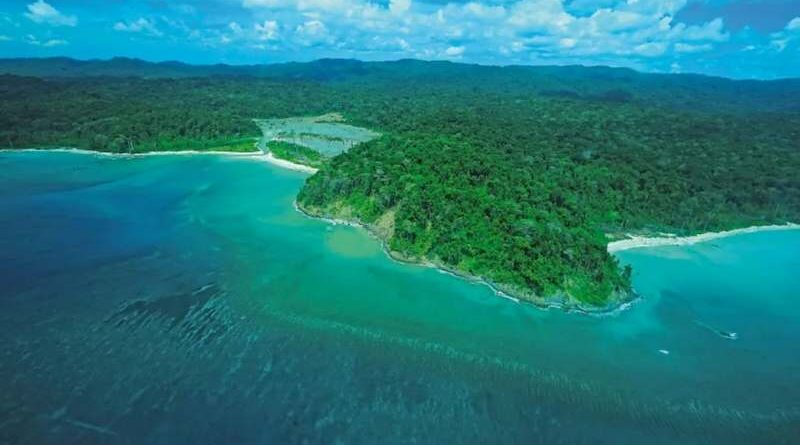
The Great Nicobar Project, formally titled “Holistic Development of Great Nicobar Island,” was approved by the Narendra Modi Cabinet in 2021. It is a proposed mega infrastructure project on Great Nicobar Island — India’s southernmost point — located near the strategically critical Malacca Strait.
The total project cost is ₹75,000 crore (revised to approximately ₹81,000 crore in 2025), conceived by NITI Aayog and being developed by the Andaman and Nicobar Islands Integrated Development Corporation (ANIIDCO) through a phased 30-year plan.
The project has four core pillars:
An International Container Transhipment Terminal (ICTT) at Galathea Bay, designed to handle 14.2 million TEUs (twenty-foot equivalent units) annually. A greenfield international airport with a 3,300-metre runway capable of handling wide-body aircraft. A 450 MVA hybrid gas-solar power plant to ensure energy self-sufficiency. Two new coastal townships along the southern tip of the island.
The project draws inspiration from global models like Singapore and Hong Kong, and aims to transform the island into a “growth pole” for the BIMSTEC region. It also aligns with India’s Maritime Vision 2030 and the Sagarmala coastal development initiative.
In a landmark decision on February 16, 2026, the National Green Tribunal (NGT) upheld the environmental clearance for the project, effectively clearing its path forward.
Why Is This Island So Special?
Great Nicobar spans 910 sq km and is a UNESCO-recognised biosphere reserve, rich in primary tropical rainforests, mangroves, coral reefs, and a wealth of endemic species — including the Nicobar megapode, the Nicobar long-tailed macaque, robber crabs, and saltwater crocodiles.
Galathea Bay, at the heart of the proposed port, serves as the largest nesting site in the northern Indian Ocean for the endangered leatherback sea turtle — the planet’s largest marine reptile.
Around 1,761 individuals belonging to the indigenous Shompen and Nicobarese tribes live on the island. A staggering 853 sq km — approximately 92% of the island — is designated as a tribal reserve under the Andaman and Nicobar Protection of Aboriginal Tribes Regulation, 1956.
The Shompen in particular are among India’s most isolated peoples — a Particularly Vulnerable Tribal Group (PVTG) of semi-nomadic hunter-gatherers numbering only a few hundred, many of whom have had virtually no contact with the outside world.
What Has Rahul Gandhi Said?
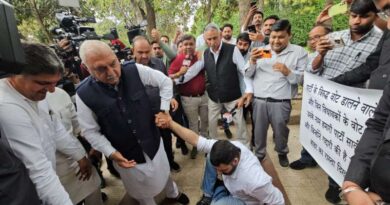
The Leader of Opposition visited Great Nicobar recently and came back firing on all fronts.
Gandhi described the project as one of the “biggest scams” against India’s natural and tribal heritage. He said he had witnessed what he described as millions of trees marked for felling and 160 sq km of rainforest condemned to destruction, with communities being ignored while their homes are snatched away.
Rahul claimed the project involves large-scale land grabbing, undermines tribal rights, results in ecological damage, and that land in the Andaman and Nicobar Islands is being taken from local populations and handed over to industrialists. He described the project as “ecological theft,” alleging that trees worth lakhs of crores are being taken, and accused the Forest Rights Act of not being implemented properly.
He also raised governance concerns, alleging administrative high-handedness by the Lieutenant Governor and a lack of accountability toward local residents and settlers who have not received proper compensation.
What Are the Independent Concerns?
Rahul Gandhi’s critique broadly overlaps with concerns raised by environmentalists, researchers, and tribal rights advocates over several years:
On ecology: Activities such as dredging, seawall construction, increased shipping traffic, light pollution, and deforestation could disrupt nesting beaches, degrade coastal habitats, and threaten marine biodiversity.
On tribals: The Shompen, many of whom remain largely uncontacted, face risks of disease transmission (due to limited immunity), cultural disruption, displacement, and erosion of traditional livelihoods. Some experts have described the potential impacts as tantamount to cultural genocide for the Shompen.
On legality: The Tribal Council of Campbell Bay has opposed the new conservation sanctuaries citing a lack of consultation. The Shompen Council revoked its no-objection certificate in November 2022, alleging lack of consent — raising questions under the Forest Rights Act, which requires Gram Sabha consent for forest diversion.
On seismic risk: Great Nicobar sits atop a major seismic fault line — an earthquake near this area contributed to the devastating 2004 tsunami, which killed 230,000 people. The day that tsunami struck, the island’s southern tip sank by around 15 feet. In July 2025, a geologist warned that an ongoing cluster of smaller earthquakes near the Nicobar Islands could signal a volcanic eruption in the Andaman Sea.
What Is the Government’s Position?
The government’s counter-argument rests on three pillars — national security, economic opportunity, and the claim that environmental and tribal safeguards are in place.
On strategic necessity: Retired military officials asserted that the project is vital for India’s maritime security, economic interests, and geopolitical positioning — particularly in countering China’s growing influence in the Indian Ocean Region. Former DG BRO Rajeev Chaudhary argued that the region has been neglected since independence and now requires urgent development, stressing that through this project India will be able to keep a watch on the Strait of Malacca — through which roughly 25% of global trade passes.
On economic gains: Major General Arvind Bhatia stated that only 1.82% of the forest of Great Nicobar Island will be used in the project, and that the international container transhipment terminal will generate annual profits of $20–40 crore for India.
On forest diversion: In August 2024, Union Environment Minister Bhupender Yadav announced that 76.98 sq km of land would be re-notified as tribal reserve to compensate for the 73.07 sq km of tribal land being used for the project.
On tribal displacement: Chaudhary asserted that the government has planned carefully to avoid displacement, saying: “The plan is foolproof.” He acknowledged that in later phases, if any relocation becomes necessary, it would only happen with the consent of the communities involved.
On legal standing: The NGT’s February 2026 order — issued by a six-member special bench — dismissed multiple challenges, noting that earlier concerns from a 2023 ruling had been addressed through a High-Powered Committee review and conditions embedded in the 2022 environmental clearance.
The Bottom Line The Great Nicobar project is not a new controversy — it has been simmering since 2021. But Rahul Gandhi’s visit has sharpened political attention on a debate that cuts across ecology, tribal rights, national security, and governance. On one side is a vision of India projecting maritime power and becoming a global shipping hub. On the other is the warning that the cost — in forests, species, and the survival of ancient tribal peoples — may be irreversible. With the NGT having cleared the project and construction inching forward, the battle has now moved from courts to Parliament and public opinion.