Bengal on the Brink: Exit Polls, Betting Markets and Gulaal All Point the Same Way
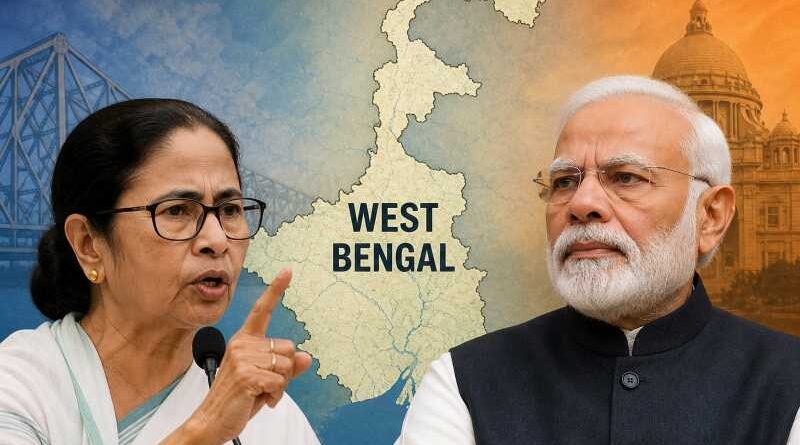
As West Bengal waits for May 4 results, a confluence of unconventional indicators — from US crypto betting platforms to colour powder sales in Kolkata’s Bara Bazar — are telling a striking story: the BJP may be on the verge of ending Mamata Banerjee’s 14-year grip on power.
With votes cast across all 294 seats of the West Bengal Assembly in two phases on April 23 and April 29, the state now holds its breath until counting day on May 4. And while official results remain days away, a battery of signals — formal and informal, domestic and international — are converging around one possibility: a historic political upset.
Exit Polls: A State in Transition
The 2026 Assembly elections have largely turned into a direct contest between the ruling Trinamool Congress (TMC) and the Bharatiya Janata Party (BJP), with Left parties and the Indian National Congress playing a limited role. The consolidated “Poll of Polls” average for the 294-seat West Bengal Assembly suggests a major shift, with the BJP projected to secure around 155 seats — just above the majority mark of 148. In 2021, the TMC secured a massive victory, winning 215 out of 294 seats, while the BJP made significant gains, increasing its tally from just three seats in 2016 to 77 seats. For the BJP to win in 2026, it would need to nearly double that tally.
US Betting Markets: Money Moving Toward Modi
Perhaps the most eye-catching indicator has come from across the Atlantic. US-based Polymarket has seen approximately $4.8 million bet on the outcome of the West Bengal election as of April 29, 2026 — the highest trading volume for any Indian state election on the platform. The markets were favouring the BJP at 56% and the AITC at 43%, while the CPI, CPI(M), INC and BGMP were being traded at less than 1%.
The trajectory of those odds is revealing. In early April, AITC was favoured at 75–80%, with the BJP at 20–25%. However, following the first phase of voting, sentiment shifted sharply toward the BJP at 54%, showing a quick acceleration. By contrast, India’s informal Phalodi Satta Bazaar — drawing on ground-level political intelligence from within the state — is pricing TMC as the majority winner with 158–161 seats and BJP at 127–130. The divergence is itself a data point: international capital is betting on change; domestic intelligence is betting on continuity.
Gulaal Sales: The Colour of Change
On the streets of Kolkata, traders in Bara Bazar — the city’s largest wholesale market for celebratory colour powder — are noticing something unusual. The sale of orange (bhagwa)-coloured powder has surged significantly, while sales of green powder have declined. Traders have commented that the demand for orange versus green colours stands at roughly 90% to 10%, respectively. Since orange is associated with the BJP and green with the TMC, this anecdotal signal has set political circles buzzing. Colour wholesaler Babulal Menot noted that every shopkeeper had stocked large quantities of green gulaal, but there is absolutely no demand for it.
What Happens on May 4?
Experts suggest that the TMC may still have an advantage in 2026, but with a narrower margin compared to its previous landslide win, pointing to a more competitive race with the BJP looking to close the gap. The race remains tight, with decisive swing constituencies in Kolkata and South Bengal likely to pivot on final vote tallies from the high-stakes Mamata Banerjee versus Suvendu Adhikari battlegrounds.
Whether Bengal’s voters have chosen continuity or change, the answer lies sealed in EVMs — and will be revealed on May 4.
Disclaimer: Prediction markets including Polymarket are unregulated and speculative. Betting on elections is illegal in India. Exit poll projections are indicative, not definitive. All figures referenced are pre-result estimates.