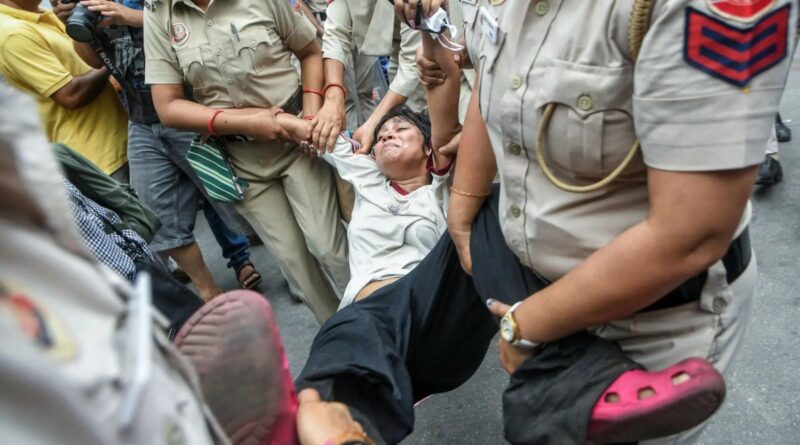
The lathi doesn’t discriminate, but the state’s attention clearly does
As police baton-charge protesters at Jantar Mantar, the silence from the government on Sonam Wangchuk’s 23-day fast speaks louder than any statement
By NewsArc Bureau | New Delhi
Monday’s scenes at Jantar Mantar — barricades breached, heads bloodied, tens of thousands pushing toward Parliament Street under a hail of lathis — were not an aberration. They were the predictable endpoint of a month-long standoff that the Union government appears to have decided is easier to outlast than to answer.
A MONTH OF SILENCE, NOT A DAY OF DIALOGUE
The Cockroach Janta Party’s protest did not begin on Monday. It has run since June 20, born out of the NEET paper leak controversy and sharpened by a Chief Justice’s now-infamous comparison of unemployed youth to cockroaches. Sonam Wangchuk, whose activism has previously moved governments to the negotiating table on Ladakh’s status, has been on hunger strike for 23 days. Twenty-three days is long enough for a government to send a junior minister, let alone frame a policy response. Instead, the loudest official communication of the day came from Delhi Police — not addressing the paper leak, not addressing the minister’s position, but disputing whether force was used at all.
WHEN “LAW AND ORDER” BECOMES THE ONLY LANGUAGE OFFERED
There is a familiar pattern here. A grievance rooted in genuine policy failure — a compromised entrance exam that determines the fate of lakhs of students — is allowed to fester until it becomes a crowd-control problem. At that point, the state has a script ready: permission was not granted, the march was unauthorised, professionalism was maintained. What it does not have ready is an answer to the substance of Wangchuk’s three conditions, none of which asked for the earth. Accountability for the education system. A meeting between MPs and protest representatives. Or, failing that, a hospital visit to a man who has not eaten in over three weeks.
That the government finds barricades and RAF deployments easier to arrange than a five-minute conversation is itself the story.
AAP’S PRESENCE AND THE OPTICS PROBLEM
The entry of Manish Sisodia, Sanjay Singh and Atishi into the protest will no doubt be used by the Centre to recast a student and youth movement as a partisan one — a familiar deflection that lets the government talk about opposition politics instead of paper leaks. But the presence of AAP leaders at Jantar Mantar does not manufacture the anger of the thousands who marched. It merely stands next to it.
A COUNTERPOINT WORTH STATING
To be fair, the government’s defenders would argue this is not indifference but restraint: that no permission was granted for a march on Parliament for legitimate security reasons that apply regardless of the protesters’ cause, that engaging every hunger strike on its own terms risks incentivising ever more extreme tactics, and that Delhi Police’s account — disputing claims of violence circulating online — deserves to be weighed rather than dismissed outright. Reasonable people can also disagree on whether the education minister’s resignation is a proportionate demand for a leak whose investigation is still ongoing.
BUT OPTICS AREN’T NEUTRAL
Even granting that defence, optics matter, and the optics on Monday were unambiguous: batons swinging on live television while the fasting man at the centre of it all entered his fourth week without so much as a written response. A government does not need to concede every demand to demonstrate it is listening. It simply needs to show up. Today, it did not.