COURT ORDERS FIR AGAINST RAHUL GANDHI OVER BRITISH CITIZENSHIP CLAIM, DIRECTS CBI PROBE
Allahabad High Court’s Lucknow bench overturns lower court’s dismissal, orders transfer of case to CBI — reigniting a controversy that has dogged the Congress leader for over a decade
LUCKNOW — April 17, 2026
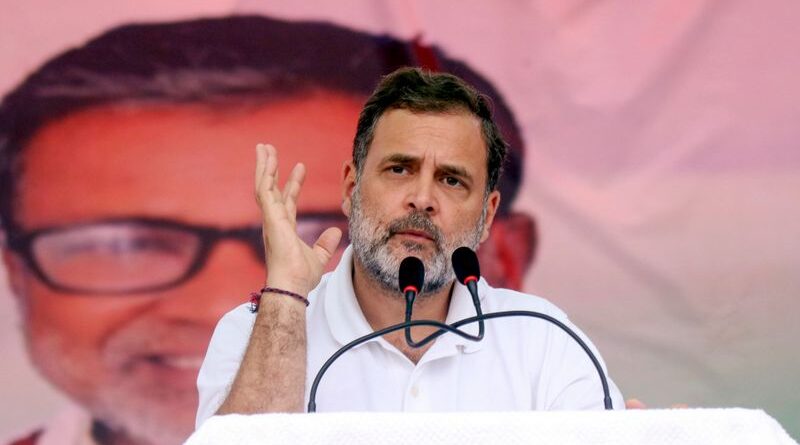
In a significant legal development, the Allahabad High Court’s Lucknow bench on Friday ordered the registration of an FIR against Congress leader Rahul Gandhi on allegations that he holds British citizenship, and directed that the case be transferred to the Central Bureau of Investigation (CBI) for a thorough probe.
The order was passed by Justice Subhash Vidyarthi on a petition filed by S. Vignesh Shishir, a Karnataka-based BJP worker, who has alleged that Gandhi is a registered voter in the United Kingdom and has participated in elections there — a charge that, if proven, would strike at the very legality of his Indian citizenship and his right to hold public office.
LOWER COURT ORDER SET ASIDE
The High Court set aside an earlier order of an MP-MLA court dated January 28, 2026, which had dismissed Shishir’s petition on the grounds that no fresh or concrete evidence regarding citizenship had been placed on record. The High Court disagreed, ruling that the magistrate had no business commenting on the truthfulness of the allegations at that stage, and ordered the FIR to be registered and the matter handed to the CBI.
During the hearing, Justice Vidyarthi had directed the Foreigners Division of the Ministry of Home Affairs to produce all relevant documents related to the case. The Ministry duly placed its files — reportedly marked “Top Secret” — before the court, which formed a key part of the deliberations before the order was passed.
WHAT THE PETITIONER ALLEGES
Vignesh Shishir claims he has placed before the court documentary evidence suggesting that Rahul Gandhi was registered as a voter in the United Kingdom and that records of his participation in British elections exist. The petition seeks the registration of a case under multiple serious provisions, including sections of the Bharatiya Nyaya Sanhita (BNS) 2023, the Official Secrets Act 1923, the Passport Act 1967, and the Foreigners Act 1946. The petitioner has argued this is a matter of national security and goes to the heart of Indian citizenship law.
In Friday’s proceedings, the Uttar Pradesh government was represented by advocate Dr. B.K. Singh, the Central government by advocate S.B. Pandey, and the petitioner by advocate Bindeshwari Pandey.
A CONTROVERSY WITH A LONG HISTORY
This is not the first time Rahul Gandhi’s citizenship has been challenged in court. In 2019, the Supreme Court had dismissed a similar petition outright. Then Chief Justice Ranjan Gogoi, sitting with Justices Deepak Gupta and Sanjiv Khanna, had remarked pointedly: “If a company mentions Rahul Gandhi as a British citizen in a form, does that make him one?” — before declaring the petition entirely without merit. That petition had cited the 2005-06 annual filings of a British company in which Gandhi had allegedly been described as a British national.
Friday’s High Court order, however, marks a fresh chapter in the long-running legal saga, with a sitting bench now directing a formal CBI investigation — a far more consequential outcome than previous courts had been willing to order.
THREE CASES AGAINST RAHUL IN UP ALONE
The citizenship case is not the only legal matter hanging over the Congress leader in Uttar Pradesh. A defamation case filed by BJP leader Vijay Mishra in 2018 is pending before the Sultanpur court, where Gandhi was granted bail in February 2024. On Friday itself, the Sultanpur court issued a sharp warning to the complainant for repeatedly seeking adjournments, with the next hearing set for April 22. A separate case is registered in a Lucknow court over Gandhi’s remarks on Veer Savarkar, in which he was fined ₹200. A third defamation case is pending before the MP-MLA court in Hathras, filed by one Ramkumar alias Ramu, alleging that Gandhi wrongly labelled acquitted youths as gang-rape accused.
Gandhi has previously faced the gravest political consequence of his legal battles when his Lok Sabha membership was revoked in March 2023 following a conviction in the Modi surname defamation case by a Gujarat court — though the Supreme Court stayed the conviction in August 2023, leading to the restoration of his membership.
Friday’s High Court order is certain to trigger a fierce political response, with the Congress likely to challenge it in higher courts. The CBI, meanwhile, now has the task of investigating one of India’s most politically charged citizenship questions.