Congress Demands Immediate Roll-Out of Women’s Reservation Law, Calls Delay a Democratic Betrayal
District Rural Women’s Congress chief Sheilza Bhatia tears into the BJP-led government at a Gurugram press conference, saying the Nari Shakti Vandan Act is being deliberately buried under the pretext of delimitation
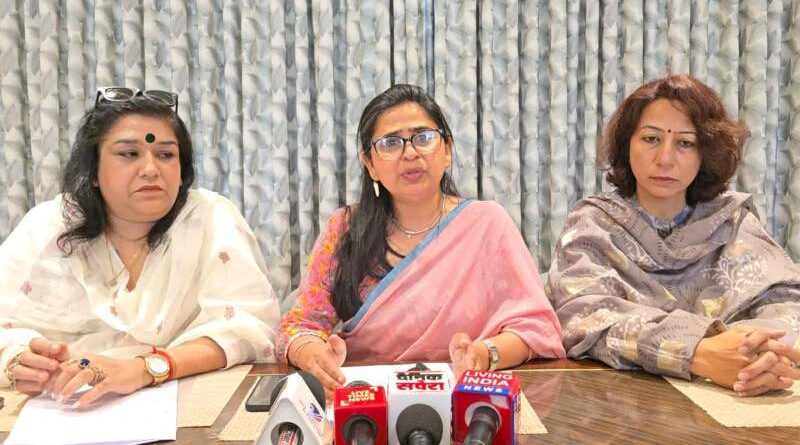
GURUGRAM, APRIL 22, 2026 — In a strongly-worded press conference held here today, the District Rural Women’s Congress of Gurugram renewed its demand for the immediate implementation of the Nari Shakti Vandan Adhiniyam — the landmark law that promises 33 per cent reservation for women in Parliament and state legislatures — accusing the ruling Bharatiya Janata Party of using procedural excuses to indefinitely delay a law it had itself championed.
The press conference was convened by Shrimati Sheilza Bhatia, President of the District Rural Women’s Congress, and was attended by Urban District Women’s Congress President Shrimati Pooja Sharma, along with office-bearers Kusum Sharma, Sharmila and several other women leaders of the Congress party.
What was said
Addressing the gathering, Sheilza Bhatia said there was no ambiguity about the Congress party’s position on the legislation. The Nari Shakti Vandan Act — enacted as the 106th Constitutional Amendment — was passed unanimously by both Houses of Parliament in 2023, and the Congress has been a consistent advocate for women’s political representation, she said.
However, she reserved her sharpest criticism for the manner in which the government has chosen to handle implementation. Rather than bringing the law into force, she argued, the ruling dispensation has tied its commencement to the completion of a fresh national Census and a delimitation exercise — effectively pushing it beyond 2029.
“If the intent were genuine, 33 per cent reservation could have been directly applied to all 543 Lok Sabha seats in the 2024 general elections itself,” Bhatia said, adding that the linkage to delimitation appeared to be a calculated move to extend the political benefits of the current constituency boundaries and prolong the government’s hold on power — a strategy she claimed the Opposition had exposed in time.
She also raised objections to what she described as the government’s tendency to bypass democratic norms, referring to a special session reportedly convened at short notice on the evening of April 16, which she said did not allow the Opposition adequate time for meaningful deliberation.
Bhatia further accused the BJP of applying double standards on women’s issues — voicing support for reservation in one breath while failing to take decisive action against the rising incidents of atrocities against women across the country.
Congress’s Four-Point Demand
On behalf of the party, Bhatia put forward four clear demands to the government:
One, that the Nari Shakti Vandan Act be enforced with immediate effect. Two, that 33 per cent reservation be applied directly to all 543 Lok Sabha constituencies without delay. Three, that if delimitation is to be carried out, it must be based on the 2026 Census rather than outdated data. And four, that women from all social categories — including Scheduled Castes, Scheduled Tribes, and Other Backward Classes — receive equitable justice under the law.
“The women of this country are no longer passive observers. They understand the politics being played in their name,” Bhatia said in her concluding remarks. “The Congress party will continue to raise this issue until women receive their rightful place in the democratic process.”
Background and Context
The Nari Shakti Vandan Adhiniyam was passed by Parliament in a special session in September 2023 with rare cross-party support, including from the Congress. The law amends the Constitution to reserve one-third of seats in the Lok Sabha, state assemblies, and the Delhi Legislative Assembly for women.
However, a critical clause in the legislation states that reservation will come into effect only after the next delimitation exercise — the redrawing of constituency boundaries — which in turn cannot begin until a fresh national Census is conducted. India’s decennial Census, originally due in 2021, was postponed due to the COVID-19 pandemic and has not yet been completed, though the government initiated the process in early 2025.
Women currently constitute roughly 15 per cent of the Lok Sabha — one of the lowest representation rates among major democracies. Critics across the political spectrum argue that the delimitation precondition effectively ensures the law remains dormant for at least a decade, even as it exists on the statute books.
The Congress party, along with several other Opposition groups, has maintained that the reservation should be made operational immediately, without waiting for delimitation, by applying it to existing constituency boundaries. The BJP, on its part, has argued that the law must follow the constitutional procedure as legislated.