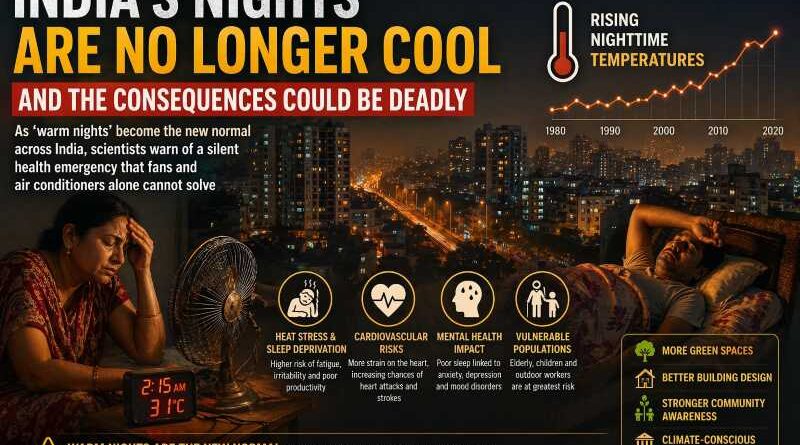
India’s Nights Are No Longer Cool — And the Consequences Could Be Deadly
As ‘warm nights’ become the new normal across India, scientists warn of a silent health emergency that fans and air conditioners alone cannot solve
There was a time when Indians could escape the brutal summer sun by retreating indoors after dark. That refuge is disappearing. Today, walls stay hot well past midnight, ceiling fans push warm air around helplessly, and even air conditioners struggle to cope. Welcome to the era of ‘warm nights’ — and experts say this is only the beginning.
What Exactly Is a Warm Night?
The India Meteorological Department defines a warm night as one where the minimum nighttime temperature exceeds the seasonal average by 4.5 to 6.4 degrees Celsius. When the gap grows even larger, it enters the category of “severely warm.” The distinction matters because the human body relies on cooler nights to recover from the physiological stress of daytime heat. When that recovery window disappears, the consequences compound rapidly.
Unlike traditional heatwaves — which were largely a daytime problem that could be managed by staying indoors, drinking water, and seeking shade — warm nights turn the home itself into a health hazard. Concrete walls and cement rooftops absorb solar energy throughout the day and slowly release it after sundown, raising indoor temperatures precisely when people are trying to sleep.
How Rapidly Is This Trend Growing?
The data paints a worrying picture. A 2025 study published in ScienceDirect found that between 1980 and 2020, the number of warm nights in India increased by up to eight days per decade, with the trend most pronounced in the northeast, northwest, and southern regions.
Research by the Council on Energy, Environment and Water (CEEW) found that over the past decade, warm nights have increased across 70 percent of India’s districts during summer months — compared to only 28 percent of districts recording a similar rise in daytime heat. In practical terms, nights are warming faster than days.
City-level data is equally stark. Between 2012 and 2022, the number of severely hot nights rose by 15 in Mumbai, 11 in Bengaluru, and around six to seven each in Bhopal, Jaipur, and Delhi. And 2025 set fresh records — as early as February, 31 states and union territories recorded nighttime temperatures at least one degree above normal, with 22 of them running three to five degrees above average. Across Indian cities over the past decade, warm nights have increased by 32 percent overall.
What Is Driving This?
Three interconnected factors are responsible.
Concrete cities trapping heat. Unlike soil or grass, which reflect sunlight relatively quickly, concrete and asphalt absorb and store it. Tall buildings in dense urban neighbourhoods block air circulation, creating what scientists call the ‘Urban Heat Island’ effect — pockets of trapped heat that refuse to dissipate after dark. This effect is intensifying in rapidly expanding cities like Bhopal and Cuttack at a rate of 0.13 to 0.18 degrees per decade, while megacities like Delhi, Mumbai, Bengaluru, Gurugram, Kanpur, and Lucknow are among the worst affected.
Rising humidity. CEEW data shows that humidity levels across North Indian plains have climbed by 10 percent over the past decade. Cities like Delhi, Jaipur, and Kanpur — historically associated with dry heat — now experience moisture levels that have jumped from around 40 percent to 50 percent. High humidity prevents sweat from evaporating, disabling the body’s natural cooling mechanism and making temperatures feel three to five degrees warmer than they actually are.
Global warming accelerating the baseline. The 2015 Paris Agreement set a global target of limiting temperature rise to 1.5 degrees Celsius above pre-industrial levels. By 2026, the earth is already running 1.44 degrees above that baseline, according to Canada’s Environment and Climate Change agency. This year will mark the 13th consecutive year that global temperatures have exceeded one degree above normal. If El Niño returns toward the end of 2026 as anticipated, 2027 could bring heat records not seen in a century.
The Health Cost Nobody Is Talking About
CEEW describes warm nights as a “silent killer” — and the label is apt. When temperatures stay above 25 degrees Celsius through the night, the body cannot complete its thermal recovery cycle, a condition known as heat stress. Scientists estimate that by 2100, the mortality risk from extreme warm nights could be six times higher than today.
The cardiovascular system takes a direct hit. The heart must work continuously harder to cool the body when external temperatures remain elevated, raising blood pressure and significantly increasing the risk of silent heart attacks or cardiac failure during sleep.
Sleep itself degrades severely. Once nighttime temperatures cross 27 degrees Celsius, the body’s most restorative sleep stages — REM and deep sleep — begin to collapse. The downstream effects include memory impairment, heightened irritability, and increased vulnerability to depression. These are not minor inconveniences; they are serious, cumulative health consequences that build over weeks and months of disrupted rest.
What Does This Mean for India’s Economy?
The financial toll is substantial and multidimensional.
India is currently buying approximately 15 million new air conditioners every year, according to the University of California’s India Energy and Climate Centre. Over the next decade, Indians are projected to purchase between 130 and 150 million new units — more than any other major economy. The domestic sector’s share of India’s total electricity consumption has already climbed from 22 percent in 2012-13 to 25 percent in 2022-23, and the trajectory is steepening.
By 2035, air conditioning alone could account for 30 percent of India’s entire electricity consumption, creating an additional demand of 180 gigawatts. The grid consequences — prolonged blackouts in major cities during peak summer — are a real and growing risk.
CEEW further estimates that if workers are unable to sleep properly through warm nights before reporting to physically demanding jobs the next day, India’s GDP could take a hit of up to 4.5 percent by 2030.
Can Air Conditioners Save Us?
Only partially — and not equitably. According to the National Family Health Survey, just 24 percent of Indian households own an air conditioner or cooler. The figure rises to 40 percent in urban areas but falls to a mere 15 percent in rural ones. In states like West Bengal and Bihar — where summer heat is among the most severe — only 5 percent of homes have air conditioning.
There is also an uncomfortable paradox at the heart of the AC solution: every unit that cools one room simultaneously pumps heat back into the street outside, raising the ambient urban temperature further. At scale, widespread AC adoption makes the Urban Heat Island effect worse, not better.
What Needs to Happen?
CEEW has issued a set of recommendations to the Indian government for inclusion in Heat Action Plans across states.
Current plans focus almost exclusively on daytime heatwaves. They urgently need to be redesigned to account for warm nights and humidity. Since 2024, heatwaves have been eligible for funding under the State Disaster Mitigation Fund — states should use these resources to build cooling shelters, establish early warning systems, and expand urban green cover.
Districts where more than half the region is classified as high heat risk should be formally designated as state-specific disaster zones, which would unlock an additional 10 percent of State Disaster Response Fund money for emergency response, agricultural compensation, and medical preparedness.
A direct cash transfer mechanism — similar to pilots already tested in Nagaland and by SEWA in Ahmedabad — should be activated automatically when temperatures cross defined thresholds, allowing daily wage workers to stay home rather than labour in dangerous heat.
Finally, doubling the energy efficiency of air conditioners over the next decade could save Indian consumers an estimated 2.2 lakh crore rupees, while simultaneously reducing pressure on the power grid.
What Can You Do Right Now?
On an individual level, a few practical steps can make a meaningful difference. Sprinkling water on concrete rooftops and walls before sleeping helps release stored heat faster. Staying hydrated with ORS, lemon water, or buttermilk supports the body’s cooling process. Light, breathable cotton clothing reduces heat retention. And special attention should be paid to the elderly and young children, who are most vulnerable to heat stress during the night.
The broader message, however, is clear: India’s summer heat problem no longer clocks out at sunset. Managing it will require policy, planning, and investment — not just personal fan-speed adjustments.