Haryana CM Nayab Singh Saini Pays Tribute to Dr. Syama Prasad Mookerjee at 125th Birth Anniversary Event in Pathankot
CM says Mookerjee’s vision for national unity was realised through abrogation of Article 370, credits Centre and Haryana government’s welfare schemes
NewsArc Bureau
Pathankot, July 5
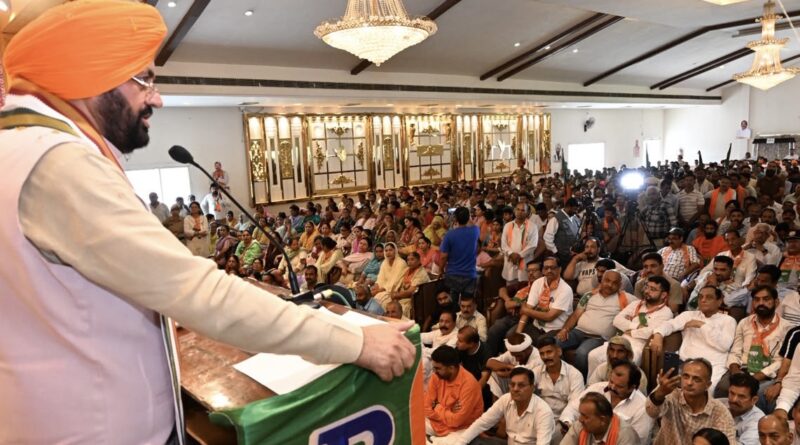
Haryana Chief Minister Nayab Singh Saini said on Sunday that Dr. Syama Prasad Mookerjee made the greatest sacrifice for the unity and integrity of the nation, asserting that the vision he had raised was fulfilled by Prime Minister Narendra Modi through the abrogation of Article 370 in Jammu and Kashmir.
Saini was addressing a gathering in Pathankot, Punjab, on the occasion of the 125th birth anniversary of Dr. Mookerjee. The event was also attended by Pathankot MLA Ashwani Sharma, former Deputy Speaker of the Punjab Vidhan Sabha Dinesh Babbu, former MLA Seema Kumari, and other senior leaders.
MOOKERJEE’S LEGACY AND SACRIFICE
Describing Pathankot as “the northern frontier of Bharat Mata,” the Chief Minister said the region’s soil carries the memory of warriors, martyrs and patriots who sacrificed for the nation’s borders. He said Dr. Mookerjee was among those rare leaders remembered not through books alone but through generations that continue to live his ideals.
The Chief Minister recalled that Dr. Mookerjee became Vice-Chancellor of the University of Calcutta at the age of 33 and was affectionately known in Bengal as the “Tiger of Bengal.” He went on to serve as India’s first Industry Minister but resigned from the Union Cabinet in 1950 over his opposition to the displacement of Hindus and Sikhs from East Pakistan and his disagreement with the Liaquat-Nehru Pact, choosing, in the CM’s words, national interest over political office.
Saini referred to Dr. Mookerjee’s call against having “do Vidhan, do Pradhan aur do Nishan” for one nation, describing it as the voice of India’s soul. He recounted that Mookerjee was arrested while attempting to enter Jammu and Kashmir without a permit from Madhopur — accompanied at the time by former Prime Minister Atal Bihari Vajpayee — and later died in custody, a death the Chief Minister described as a supreme sacrifice for national unity.
LINK TO ARTICLE 370 ABROGATION
The Chief Minister said the mission for which Dr. Mookerjee sacrificed his life was completed on August 5, 2019, when Prime Minister Modi and Union Home Minister Amit Shah abrogated Article 370, asserting that the Tricolour now flies with pride “from Kashmir to Kanyakumari and from Attock to Cuttack.”
CLAIMS ON GOVERNANCE AND WELFARE
Saini credited the Union government’s initiatives — including Digital India, Skill India, Make in India, Ayushman Bharat, and infrastructure projects such as Vande Bharat trains and expressways — with transforming India’s global standing over the past decade. He said Haryana had integrated its Chirayu scheme with Ayushman Bharat to widen healthcare coverage and had set up 17 medical colleges in line with the Centre’s push for a medical college in every district.
He claimed nearly 2 lakh youth in Haryana had received government jobs without “parchi-kharchi,” and said Haryana had become the first state to procure all 24 crops at Minimum Support Price. He added that women in the state are being given ₹2,100 per month, and that crop-loss compensation to farmers had risen to nearly ₹16,500 crore since 2014, compared to ₹1,136 crore paid by the Congress government between 2004 and 2014.
CRITICISM OF PUNJAB GOVERNMENT
Saini said he felt “concern and pain” over the state of affairs in Punjab, claiming that promises made to the state’s youth, farmers and women remained unfulfilled, and alleging that many young people in the state were caught in drug addiction. He said Punjab’s farmers continued to struggle for fair prices for their produce.
He said the future of Punjab would be decided by its own people — farmers, youth, and women — rather than by “Delhi’s politics,” and said the BJP was seeking an opportunity to serve the people of Punjab rather than power, expressing hope that the state would once again become a “Rangla Punjab.”